I found a fun short piece from the BBC on the origins of writing around the world which I thought people might enjoy.
I finished my Art History midterm today. I think it went well, but one never knows. Lots of Plato to read for tomorrow.
Tuesday, August 23, 2011


Monday, August 22, 2011
Flamingos for Thought
 |
| Photo Credit: Wikimedia Commons |
I learned in my high school biology class that flamingos develop their traditional pink color from pigments in the algae that they eat, but I did not know why they stood on one leg until now. The article is great, I highly suggest it.
Sunday, August 21, 2011
Nox, A Review
I just finished Anne Carson's Nox , which was a Christmas gift from one of our oldest family friends and his wonderful girlfriend who is a famous novelist. On the back of the "book," Carson describes her work thus: "When my brother died, I made an epitaph for him in the form of a book. This is a replica of it, as close as we could get." I put the word "book" in quotations marks because this work is not, strictly speaking, a book. It is, rather, a box with a fold out visual-and-prose poem and at the same time, an associative reading of Catullus 101.

 The Catullus poem is beautiful, as is Anne Carson's work. While being a poem and a journey in grief, it is also a character study and a postmodern novel; the readers must flesh out the complicated lives of the characters through (often literal) fragments. It is an engaging read which develops a sort of ethos of sadness as well as a desire for inquiry.
I don't want to spoil it; I suggest you read it. Her work is wonderful.
, which was a Christmas gift from one of our oldest family friends and his wonderful girlfriend who is a famous novelist. On the back of the "book," Carson describes her work thus: "When my brother died, I made an epitaph for him in the form of a book. This is a replica of it, as close as we could get." I put the word "book" in quotations marks because this work is not, strictly speaking, a book. It is, rather, a box with a fold out visual-and-prose poem and at the same time, an associative reading of Catullus 101.I don't want to spoil it; I suggest you read it. Her work is wonderful.
Friday, August 19, 2011
Wine Snob: 1992 Husch Reserve Pinot Noir
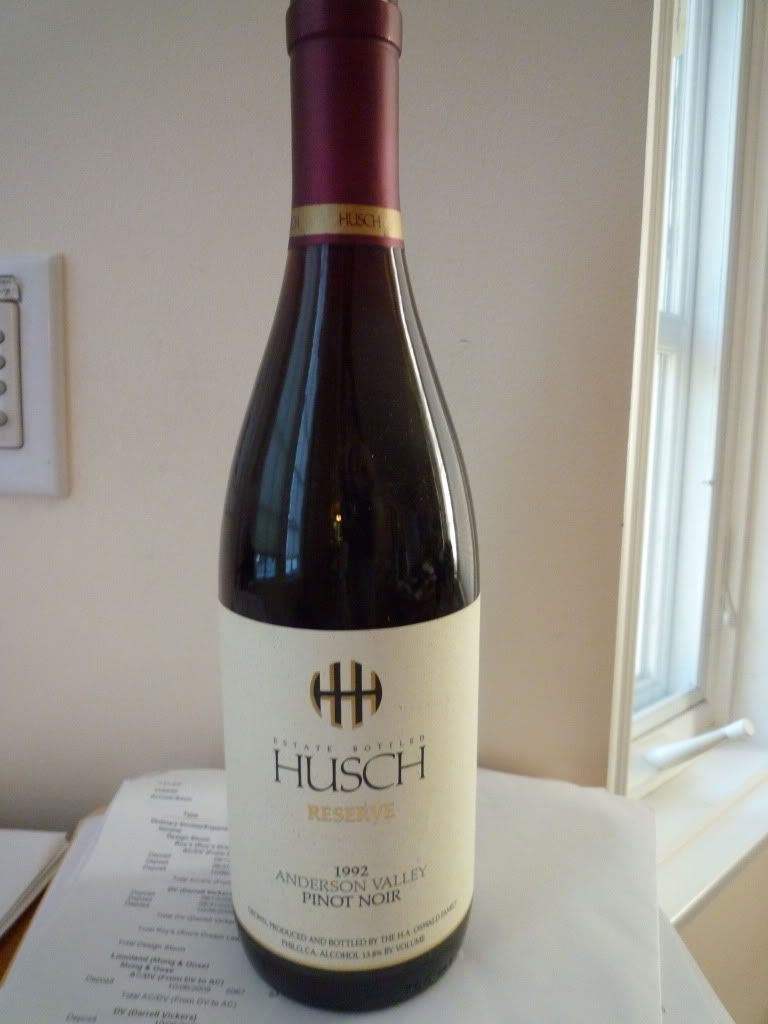 |
| Husch 1992 Reserve Pinot Noir |
I was kind of nervous at first. When the waiter poured the wine it was distinctly brown. I think he saw the look on my face because he told me that if I left it to breath, it would probably be quite nice. He was right: after only a few moments the wine turned from chestnut brown to a sort of brick red. The flavor progressed to become a very light, round, warm wine with minerals and a hint of pink pepper. It retained the slight tannic bite at the end.
I always like to compare old wines (when I get the chance to have them) to their original descriptions. This wine certainly changed from when it was bottled in 1994 after a 20-month period in oak barrels (this was Husch's first reserve pinot noit). They said that it tasted of cherries, violets, and cinnamon with a long, softly tannic finish.
If there are any bottles out there to try, I highly recommend it. Let it sit for at least an hour before tasting.
Thursday, August 18, 2011
Upcoming
I have my German midterm tomorrow. I am a little nervous, but I think it is going to be ok. After that, I will post a review of the delicious wine I had tonight and maybe go to the doctor because my cold is getting worse.
Tuesday, August 16, 2011
Slightly Ill Meditations on Textbooks
Although I have been taking good care of myself (sleep, veggies, fruits, vitamins, Greek, scholarship, a little Latin, etc), my cold seems to have relapsed and I feel rather ill. Consequently, my understanding of the world (as it always does when I am distracted by a painful throat, the sniffles, etc, declines rather sharply. Although I struggled through both some Crito and even a poem by Catullus this afternoon (110
 ), my ability to effectively take in information sharply declined after a long art history lecture in a darkened room. As such, instead of continuing with Plato, Homer, or even reading Zuckert
 for my research, I have been reading a textbook.


 My only mandatory class for the fall (aside from at least one course in each Greek and Latin) is a seminar on, essentially, how to produce classical scholarship. I am not sure what this entails precisely, although I seem to remember something about producing a term paper, the only book assigned for the class is a recently-published research manual by David Schaps called the Handbook for Classical Research
 . After I began nodding off while reading Plato's Philosophers (which quite interesting and this demonstrates clearly that I do not feel well), I decided to something with a simpler tone and point: my new textbook.
Like any good textbook, Schaps' work is engaging without being particularly challenging. Schaps has a strong personal style in his writing that is amenable, even if his opinions, at times, can be rather irritating (especially when he presents them as universal sentiments). However, there is something that feels wrong about the book. Although I am only 50 pages into the book, I get the distinct feeling that Classical research is simply not a subject that can be stuffed into the form of a textbook. Furthermore, although Schaps' distinct voice makes the book more engaging that it might be with a more distant author, it also causes me as the reader to constantly question his qualifications for writing such a book. The only place I have heard his is in one brief discussion of ancient coinage. It caused the more cynical part of me to wonder whether he has children to put through college, because certainly a general research handbook is going to sell better than the Economic Rights of Women in Ancient Greece .
To be sure, there are a lot of things that I still do not know. Until a few days, I had never researched fragments and my examination of the Teubner volume in the library containing Pindar 169a gave me some interesting insights (like how many times Plato's dialogues quote this fragment), but if it indeed contained the information I sought, I did not understand it. I have not gotten to examine Schaps' explanation of research with fragments yet so I do not know if he would be helpful. I certainly could have used this book in high school or early college when, while I had access to them, I did not understand what a commentary was and I sailed through my texts blindly until Propertius II helped me out in my Aeschylus class. Yet, at this moment in my career, I am less in need (for example) of a textbook that explains what scholia is than a textbook that provides a detailed understanding of different types of scholia and how to read them (e.g Ancient Greek Scholarship
 ) or perhaps (more pertinent ant the moment) a detailed monograph on strategies to deal with textual fragments and their sources.
Maybe Schaps refers students to resources like this (I do know that he mentions Eleanor Dickey's book), but even if that were the case, it seems like a fruitless mission to write a book on a topic that is designed only as a chaperone to bigger and better resources instead of writing (or hiring someone else to write) analysis at the level necessary for rigorous undergraduates or less experienced graduate students as the book, by it's very nature (and the assumption made clear in the introduction) is geared solely toward individuals who intend to research and publish in the field. More thoughts as I get farther along (and hopefully as I become more coherent as my cold wains).
Notes 08/17/11: I was thinking that the book was declining further when I came to a chapter entitled "Book Reviews" (Schaps 57-65), but I was impressed to discover that the chapter was not instruction on how to read a book review, but on how to write one that might be accepted by a journal and what types of journals tend to publish them. However, the jury is still out.
Note 08/19/11: Once again I must add a positive addendum to my review. Although I have used many dictionaries in my time as a student of the classics, I still found Schaps' chapter on lexicography illuminating when it came to dictionaries (Schaps 69-80). It was nice to find out that there is a dictionary of Mycenean Greek (although, apparently, the best one is in Spanish ) and that Woodhouse
 is the only full English-Classical Greek dictionary around, but other smaller ones, such as one by by James Morwood
 (good to know for prose composition).
and even a poem by Catullus this afternoon (110), my ability to effectively take in information sharply declined after a long art history lecture in a darkened room. As such, instead of continuing with Plato, Homer, or even reading Zuckert for my research, I have been reading a textbook. . After I began nodding off while reading Plato's Philosophers (which quite interesting and this demonstrates clearly that I do not feel well), I decided to something with a simpler tone and point: my new textbook.Like any good textbook, Schaps' work
is engaging without being particularly challenging. Schaps has a strong personal style in his writing that is amenable, even if his opinions, at times, can be rather irritating (especially when he presents them as universal sentiments). However, there is something that feels wrong about the book. Although I am only 50 pages into the book, I get the distinct feeling that Classical research is simply not a subject that can be stuffed into the form of a textbook. Furthermore, although Schaps' distinct voice makes the book more engaging that it might be with a more distant author, it also causes me as the reader to constantly question his qualifications for writing such a book. The only place I have heard his is in one brief discussion of ancient coinage. It caused the more cynical part of me to wonder whether he has children to put through college, because certainly a general research handbook is going to sell better than the Economic Rights of Women in Ancient Greece.To be sure, there are a lot of things that I still do not know. Until a few days, I had never researched fragments and my examination of the Teubner volume
in the library containing Pindar 169a gave me some interesting insights (like how many times Plato's dialogues quote this fragment), but if it indeed contained the information I sought, I did not understand it. I have not gotten to examine Schaps' explanation of research with fragments yet so I do not know if he would be helpful. I certainly could have used this book in high school or early college when, while I had access to them, I did not understand what a commentary was and I sailed through my texts blindly until Propertius II helped me out in my Aeschylus class. Yet, at this moment in my career, I am less in need (for example) of a textbook that explains what scholia is than a textbook that provides a detailed understanding of different types of scholia and how to read them (e.g Ancient Greek Scholarship) or perhaps (more pertinent ant the moment) a detailed monograph on strategies to deal with textual fragments and their sources.Maybe Schaps refers students to resources like this (I do know that he mentions Eleanor Dickey's book
), but even if that were the case, it seems like a fruitless mission to write a book on a topic that is designed only as a chaperone to bigger and better resources instead of writing (or hiring someone else to write) analysis at the level necessary for rigorous undergraduates or less experienced graduate students as the book, by it's very nature (and the assumption made clear in the introduction) is geared solely toward individuals who intend to research and publish in the field. More thoughts as I get farther along (and hopefully as I become more coherent as my cold wains).Notes 08/17/11: I was thinking that the book was declining further when I came to a chapter entitled "Book Reviews" (Schaps 57-65), but I was impressed to discover that the chapter was not instruction on how to read a book review, but on how to write one that might be accepted by a journal and what types of journals tend to publish them. However, the jury is still out.
Note 08/19/11: Once again I must add a positive addendum to my review. Although I have used many dictionaries in my time as a student of the classics, I still found Schaps' chapter on lexicography illuminating when it came to dictionaries (Schaps 69-80). It was nice to find out that there is a dictionary of Mycenean Greek (although, apparently, the best one is in Spanish
) and that Woodhouse is the only full English-Classical Greek dictionary around, but other smaller ones, such as one by by James Morwood (good to know for prose composition).
Monday, August 15, 2011
The Joys of Research
Over the past few days, I have begun once again working on editing my thesis. This process is mostly for graduate school applications, but some is as a tonic for my own soul. Although my thesis certainly did what it needed to and was relieved well, it failed to entirely answer the questions upon which I wrote it. I know what I cannot spend my life fine-tuning my undergraduate thesis, as Propertius II gently reminded me, but I just do not feel like the project is finished yet.
I love researching, which I think is part of the reason that I love Plato. My favorite thing is finding that nugget of text that others missed and figuring out the possibilities of what it means. Plato is full of these little moments that could have huge interpretive significance. I have spent the last few days researching the possible dramatic date of the Laws looking for the clues dropped within the text itself because I think that Catherine Zuckert, who has a wonderful chapter on the dramatic (not compositional) date of the laws in her book does not fully address some of the complications with her position.
Through this process I realized the truth of something a friend said: she told me that not everyone is a researcher. At the time, I thought this was absurd. I figured that if someone liked the topic enough, they were bound to like researching it. However, over the past few days I've been able to see her point. Someone researching needs to not only like the topic, but rather enjoy what a blogger on the CAMPVS refers to as "the hunt." I might put it rather differently; for me it's more like a hike which is long, sweaty, and arduous (although it is invigorating as well) with the "epiphany moment" as the peak of the mountain where the hiker feel like (s)he can suddenly see the entire world (or sometimes suddenly realizes it's not the peak at all).
I love researching, which I think is part of the reason that I love Plato. My favorite thing is finding that nugget of text that others missed and figuring out the possibilities of what it means. Plato is full of these little moments that could have huge interpretive significance. I have spent the last few days researching the possible dramatic date of the Laws looking for the clues dropped within the text itself because I think that Catherine Zuckert, who has a wonderful chapter on the dramatic (not compositional) date of the laws in her book
does not fully address some of the complications with her position.Through this process I realized the truth of something a friend said: she told me that not everyone is a researcher. At the time, I thought this was absurd. I figured that if someone liked the topic enough, they were bound to like researching it. However, over the past few days I've been able to see her point. Someone researching needs to not only like the topic, but rather enjoy what a blogger on the CAMPVS refers to as "the hunt." I might put it rather differently; for me it's more like a hike which is long, sweaty, and arduous (although it is invigorating as well) with the "epiphany moment" as the peak of the mountain where the hiker feel like (s)he can suddenly see the entire world (or sometimes suddenly realizes it's not the peak at all).
Wednesday, August 10, 2011
Bread for Cerinthus
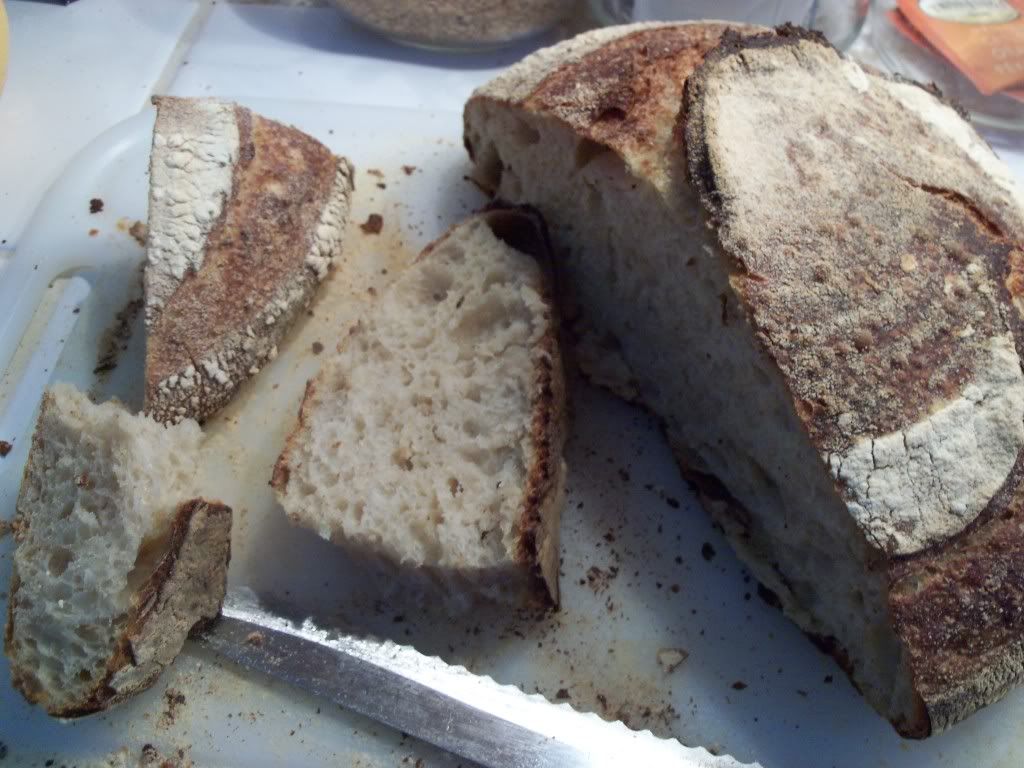 |
| Debris |
 in order to explore other options, I keep coming back to it. When Cerinthus was here, I made us a loaf of the Country Bread for a picnic lunch. It was lovely.
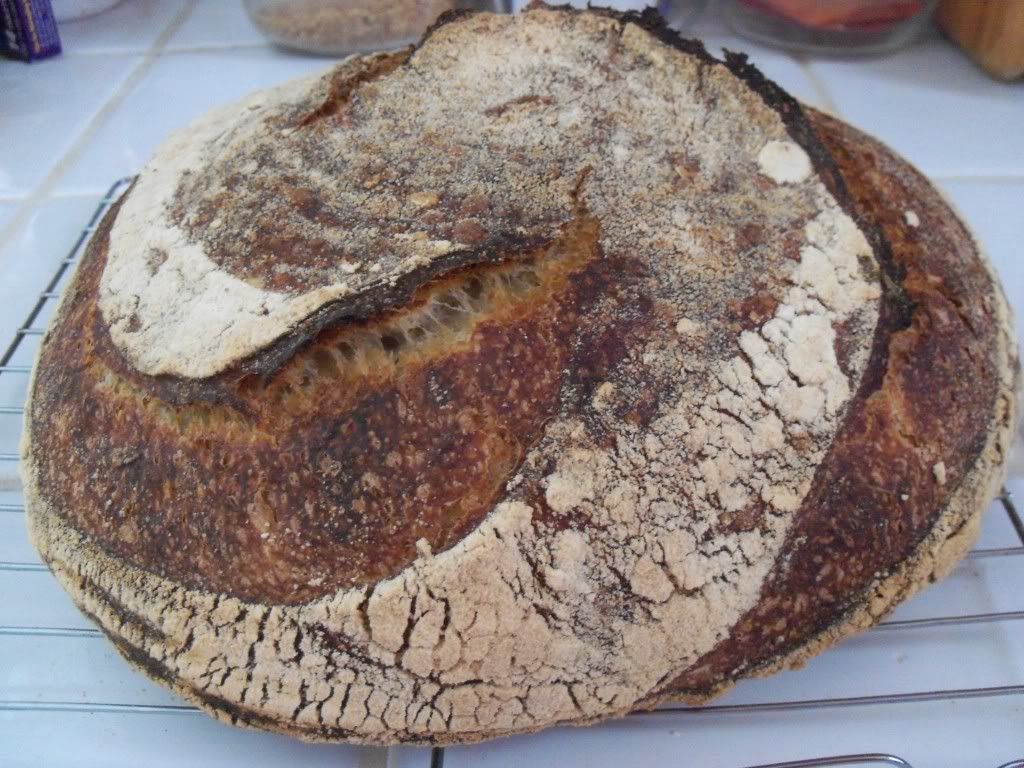 |
| Crackly, wonderfully caramelized crust. |
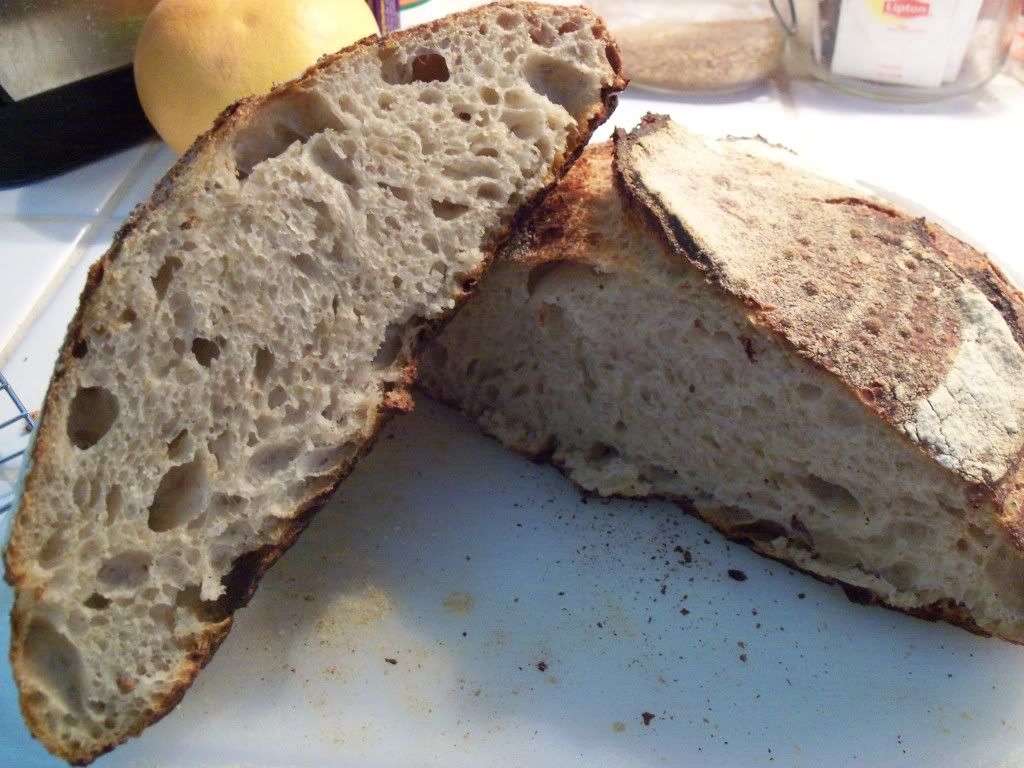 |
| Moist, soft, flavorful crumb. |
Subscribe to:
Posts (Atom)