Unlike everyone else, I had my last final on Monday so my spring break was cut a little bit short. However, I managed to put the break to good use and spend a lot of time hanging out out with friends and not getting any sleep. Unfortunately, I caught a cold from my insane lifestyle for the past few days which involved lots of friends and wine and visiting a couple of museums and even a spa. Classes start again on Tuesday. In the meantime, I promised one of my tutoring students that I would read the The Hunger Games because she was shocked and appalled that I had not yet read it.
I decided I didn't want to buy the book so I check out the ability to borrow a book from Amazon that is one of the new feature of Amazon prime. It actually works really well with novels and I think that I am going to really enjoy this capacity during the summer. I just borrowed the second book.
In general, I don't think the The Hunger Games is particularly fantastic. It kept me awake and reading while I've been sick, but it's neither particularly well written or particularly gripping. It surprises me that it is such a hit, because it does not have the magical world of Harry Potter or anything. But maybe the second installment will prove more fascinating...
Showing posts with label Amazon. Show all posts
Showing posts with label Amazon. Show all posts
Sunday, April 1, 2012


Wednesday, September 15, 2010
Updates: Kindle and Free Books
I wrote two blogposts of the last few weeks which I feel are in need of updating: A Bibliophile's Review of the Kindle DX and Problems With Free Books. (I also recently updated the Blog on the Minoan Octopus Jar.)


Endnotes
Kindle for Cooks
One of the things that I did not mention in my original review is my use of the kindle for cooking. I use it in two ways. One is to download and put recipes on my kindle and stand it up on my counter-top. This only works, obviously if one downloads a cookbook or creates a PDF or MOBI document. I used a particular case, a platform kindle case , that allowed me to stand the kindle upright so that I could read the recipes easily. The other way that I used the kindle was to have it read to me while I was cooking. I downloaded a free version of The History of the Peloponnesian War
 and had the Kindle read to me while I was cooking so that I did not waste time [1]. It was pretty helpful, except for the pronunciation of the Greek names. For example, Themistocles (the-mist-oo-cleez) was pronounced (the-mis-do-cls). Although the humanoid voices can be kind of annoying, it gets the information across and entertainment can be found by poking fun at it.
, that allowed me to stand the kindle upright so that I could read the recipes easily. The other way that I used the kindle was to have it read to me while I was cooking. I downloaded a free version of The History of the Peloponnesian War and had the Kindle read to me while I was cooking so that I did not waste time [1]. It was pretty helpful, except for the pronunciation of the Greek names. For example, Themistocles (the-mist-oo-cleez) was pronounced (the-mis-do-cls). Although the humanoid voices can be kind of annoying, it gets the information across and entertainment can be found by poking fun at it.As a random technological sidenote, I have had my phone for 6 years and it is finally beginning to break down (people cannot hear me when I answer the phone and I have to shout, etc). Does anyone have a good recommendation?
A Clarification and More Amazing Free Books
I realized that I never explained the meaning of the title "The Problems of Free Books." The idea is that Google Books provides some downloadable free books as well as providing essentially an enormous, no-membership-required digital library that allows the reader to browse through editions of books online for the purposes of research, as well as for the ability to preview books online. For any other book, there is the difficulty of finding the book in the first place, making sure that it is the correct edition, etc. Speaking of free ebooks, there is another Amazing Site (referred to me by Propertius II) that has a bunch of academic books marked "public" which can be read online.
Endnotes
- At the time when I was doing this, I was taking a class on Thucydides: Book 1
in Greek, I was attempting to read the rest of Thucydies' History of the Peloponnesian War for context. Usually I would read the beautiful Landmark Edition
, which was a wonderful gift from my parents, but I ended up just trying to breeze through the kindle edition
Monday, September 6, 2010
A Bibliophile's Review of the Kindle DX
I have had my wonderful Kindle DX for a year now. It was a wonderful and incredibly useful gift from a close family friend. I think that is ample time to explore the benefits of the Kindle and also to demonstrate that owning an eReader is not going over to the dark side.
As I have mentioned before, I have a visual processing disorder, so reading off of anything (and especially a computer screen) for any length of time is difficult. Unfortunately, like at any university, many of my classes required supplementary readings that were held by online reserves, and had to be read either on a computer screen or by printing them out. Although I read many of them on paper, printing at school, as well as my own printing (with the cost of ink/toner) was expensive. Both of the two doctors who I consulted recommended the Kindle DX to me, because of the e-ink screen and because font size and word spacing are easily changeable, as well as the reading aloud function.
I was very skeptical, at first, of the idea of an electronic reader. I am a serious bibliophile (as presumably anyone can guess from the bookshelf at the top of my blog and my reading list). I love the feel of books in my hands, the tactile sensation of turning the pages and hearing the distinctive sounds of the paper. I love new books, so shiny and perfect one hardly wants to open them. I ordered a copy of Immanuel Kant's Groundwork for the Metaphysics of Morals that releases the distinctive smell of jasmine soap upon opening. I also love used books, a little worn or with an inscription by the previous owner. For one birthday, my parents bought me a copy of Idle Thoughts of an Idle Fellow
 from the mid 1890s, with a beautiful sky-blue leather cover and accents of gold leaf, a little worn on the spine with use.
However, when I received my Kindle DX, I was almost immediately won over. The device itself is sleek and lightweight (and the new graphite ones are actually even sleeker). I can carry 3,500 books and documents. While I was at school, I no longer had to print, I could do my electronic reserve reading right on my Kindle [1]. Furthermore, I could download any PDF from Jstor or any of the wonderful electronic journal archives for research or pleasure reading and read them or save them for a later date. There are also a ton of free books on Amazon and Project Gutenberg (mobi documents) for the kindle, which can be annotated the same way that a traditional kindle document can.
I also found that writing my thesis, the Kindle was a real lifesaver. One of the primary texts that I used was Plato's Laws . I read the Laws in English, and then read selected sections I needed in the Greek. Much of the time I needed to refer to specific passages that all used the same word or phrase and sometimes either calculate the frequency of those phrases or discuss their placement in the text. Although I used the Thesaurus Linguae Graecae for much of the searching, I also used the kindle search function in the English version in order to expedite certain processes as well as to contain vast annotations on particular passages.
I do have a number of criticisms of the kindle, some of which Amazon has addressed and fixed.
Concerns that Amazon has recently fixed:
still need to fix:
Overall, the kindle is awesome. I now only have to lug one book and a kindle on a trip, instead of taking 3-4 books with me. I love my kindle so much that I bought a second one off a friend (who got it as a gift and was not a fan) and gave it to my mom, who also loves it.
If anyone is interested, the case I have is also awesome.
Update 02/14/11: There are new updates for the kindle. The first two problems (page numbers from the print editions and borrowing books) have now been fixed, although the former has only been solved on certain kindle books and only for the newest editions of the Kindle 6" . I discuss this in a recent blogpost. The borrowing books feature is also questionable. The book leaves your kindle and moves to the other person's kindle for either 2 or 3 weeks, and then it returns. Each book can only be lent once. As a person who lends out a lot of books and who is loaned a lot of books, this system seems pretty ridiculous. However, it's better than nothing.
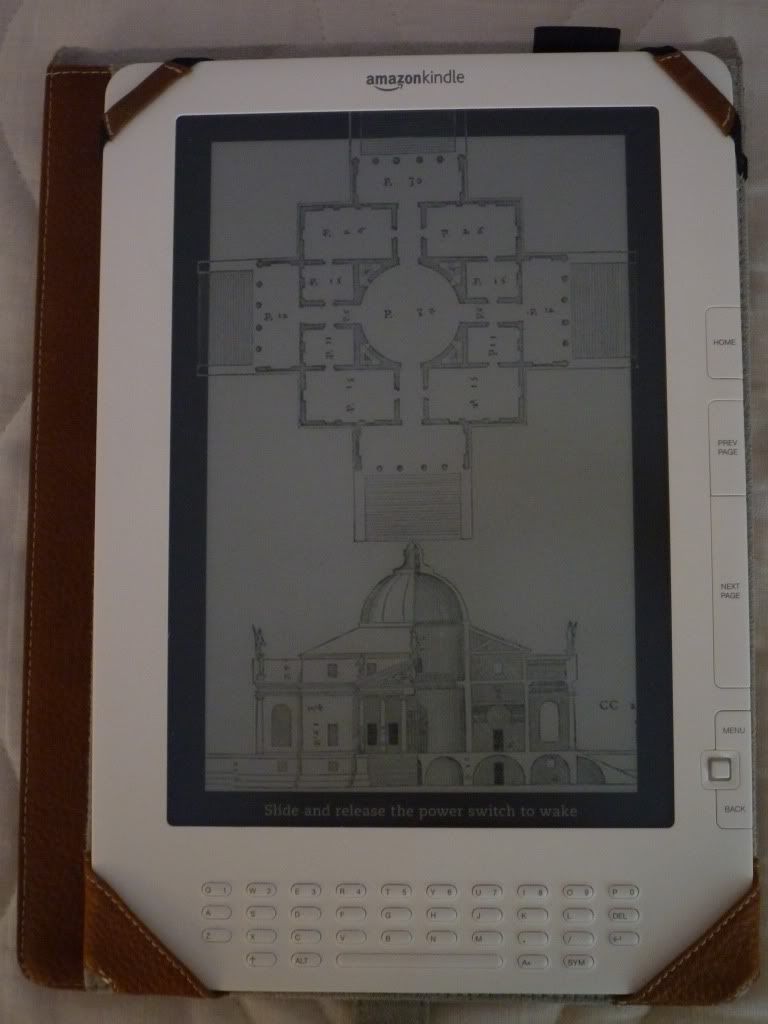 |
| My Kindle DX |
to me, because of the e-ink screen and because font size and word spacing are easily changeable, as well as the reading aloud function. I was very skeptical, at first, of the idea of an electronic reader. I am a serious bibliophile (as presumably anyone can guess from the bookshelf at the top of my blog and my reading list). I love the feel of books in my hands, the tactile sensation of turning the pages and hearing the distinctive sounds of the paper. I love new books, so shiny and perfect one hardly wants to open them. I ordered a copy of Immanuel Kant's Groundwork for the Metaphysics of Morals
that releases the distinctive smell of jasmine soap upon opening. I also love used books, a little worn or with an inscription by the previous owner. For one birthday, my parents bought me a copy of Idle Thoughts of an Idle Fellow from the mid 1890s, with a beautiful sky-blue leather cover and accents of gold leaf, a little worn on the spine with use.However, when I received my Kindle DX, I was almost immediately won over. The device itself is sleek and lightweight (and the new graphite ones are actually even sleeker). I can carry 3,500 books and documents. While I was at school, I no longer had to print, I could do my electronic reserve reading right on my Kindle [1]. Furthermore, I could download any PDF from Jstor or any of the wonderful electronic journal archives for research or pleasure reading and read them or save them for a later date. There are also a ton of free books on Amazon
and Project Gutenberg (mobi documents) for the kindle, which can be annotated the same way that a traditional kindle document can.I also found that writing my thesis, the Kindle was a real lifesaver. One of the primary texts that I used was Plato's Laws
. I read the Laws in English, and then read selected sections I needed in the Greek. Much of the time I needed to refer to specific passages that all used the same word or phrase and sometimes either calculate the frequency of those phrases or discuss their placement in the text. Although I used the Thesaurus Linguae Graecae for much of the searching, I also used the kindle search function in the English version in order to expedite certain processes as well as to contain vast annotations on particular passages.I do have a number of criticisms of the kindle, some of which Amazon has addressed and fixed.
Concerns that Amazon
has recently fixed:- No Organization-- The newest software update that I downloaded allows for collections of books, which means that I can organize the books in any way I choose. This is a huge help given how many ebooks I have.
- No Zoom-- The newest software update also includes a zoom for PDF documents, which is very helpful.
still need to fix: - No way to refer to page numbers from the print edition. I was lucky with Plato, because Plato scholars refer to Stephanus pagination, rather than page numbers from any particular edition. However, this can be a serious issue when writing academic papers. It usually means that one has to check a print edition of the library as well and then cross-reference, which is really lame. It also provides a difficulty in citing pages for class discussion, which is part of why the kindle experimentation program at universities was not a raging success (my school included).
- No way to borrow books. This is truly unfortunate. I lend print copies of my books to my friends all the time, and my mother and I frequently both read a book. I don't want to have to lend someone my kindle, because that is lending a portion of my library and it keeps all of my notes.
- The TERRIBLE pronunciation of times and sometimes problematic inflection of the reader. I know, it's difficult to get a computer to pronounce things properly. When I was taking a Thucydides course where we were focusing intently on Book I (in Greek), I would listen to the rest of the book (in English) while I was cooking or cleaning to provide context. I often had to go over and check the text because I could not understand the names and place names to which she was referring (I usually listened to the female voice).
- Problematic edition differences. According to an Amazon representative that I talked to once, publishing companies put out their own version of the kindle books rather than Amazon doing it themselves. I understand this principle. However, I cannot understand the lack of standards between different publishers. One of my favorite features of the kindle is linked footnotes, and a lot of books just have endnotes in the back instead of the linked footnotes. It seems like it would be easy to have across-the-board standards for the different companies.
Overall, the kindle is awesome. I now only have to lug one book and a kindle on a trip, instead of taking 3-4 books with me. I love my kindle so much that I bought a second one off a friend (who got it as a gift and was not a fan) and gave it to my mom, who also loves it.
If anyone is interested, the case
I have is also awesome.Update 02/14/11: There are new updates for the kindle. The first two problems (page numbers from the print editions and borrowing books) have now been fixed, although the former has only been solved on certain kindle books and only for the newest editions of the Kindle 6"
. I discuss this in a recent blogpost. The borrowing books feature is also questionable. The book leaves your kindle and moves to the other person's kindle for either 2 or 3 weeks, and then it returns. Each book can only be lent once. As a person who lends out a lot of books and who is loaned a lot of books, this system seems pretty ridiculous. However, it's better than nothing.Endnotes
- For anyone interested, any documents that have been scanned with facing pages can be split into two separate documents with your pdf reader/editor program and then merged by alternate pages with PDFsam. This takes a few minutes, but if you do it once a week or so with all of the electronic reserve documents, it really helps. I got this tip from a friend.
Subscribe to:
Posts (Atom)