Showing posts with label Sandwich Loaf. Show all posts

Thursday, March 28, 2013

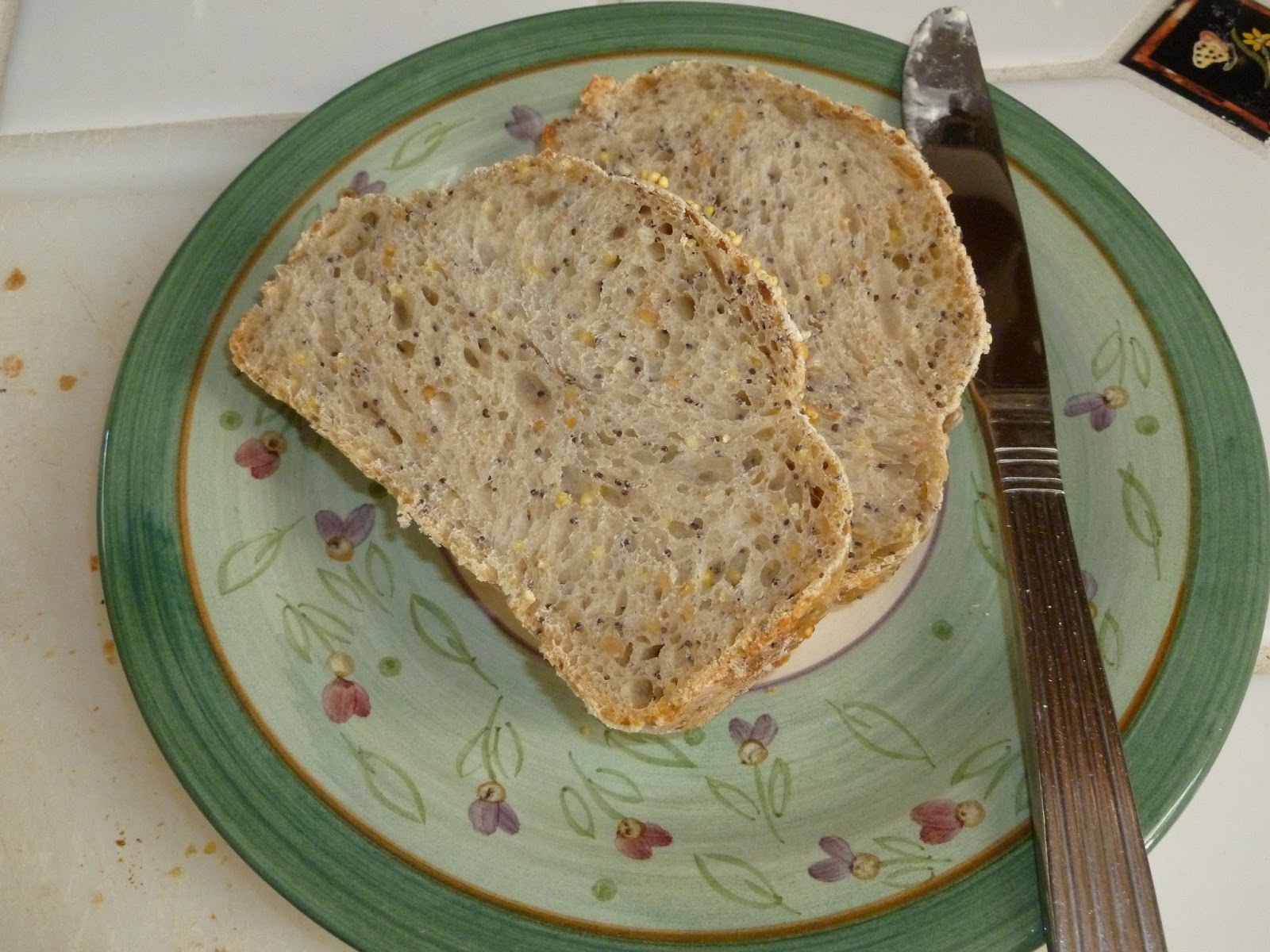
Pumpkin Seed Bread (a work in progress)

Pumpkin Seed Bread
When I was in Ireland, Egnatius' father brought home some bread. Usually, I'm not a big fan of sandwich bread, but this bread was fantastic. Really fantastic. It was some kind of multigrain or whole grain bread with pumpkin seeds. However, I couldn't figure out what was in it.

Scrolling though Yeast Spotting, I discovered this bread which looked exactly like it. So, I thought, why not try it?

Pumpkin Seed Spelt Sandwich Bread
Ingredients
  • 250 g whole wheat 100% starter
  • 200 g water + a little bit extra for adjustments and soaking the grains (maybe 50g extra?)
  • 300 g fresh ground spelt flour
  • 50 g bread flour
  • 1 tablespoon flax seeds
  • 1 tablespoon amarneth
  • 4 tablespoons pumpkin seeds (mine were dry roasted, but you can do either)
  • 6 g salt
  • 1 tablespoon honey
  • 2 tablespoons olive oil
Directions
  • Place all ingredients except salt, oil and honey in the bowl of the mixer. Mix for a minute low, cover and let stand 15 minutes. 
  • Repeat a minute of mixing and 15-minute rest. I would do this by hand, because my mixer didn't like the dough for some reason.
  • Add salt and honey and mix on low speed (or mix by hand), when they are integrated add oil, a tablespoon at a time, or five minutes when we got a soft dough up a little speed and knead for another minute. 
  • Remove the dough and place it in a bowl, cover and leave for two hours doing slightly folded table in the same bowl every half hour, a total of three sets of folds. 
  • Remove the dough to a lightly floured surface and spread with the palms of your hands into a rectangle, roll a way that is somewhat shorter than the mold that will be used. 
  • Grease the mold slightly and place the bread inside, paint the surface with water and place a handful of pumpkin seeds over lightly pressing them to make them stick to the wet dough, and cover.
  • Place it in the refrigerator overnight.
  • In the morning, let it sit out for about half an hour while the oven heats up.
  • Bake in preheated oven at 390 ° F, and bake five minutes and lower the temperature to 350 ° -375° F, bake half an hour in total, first 15 minutes under steam.
Bread
The bread still needs a lot of work. If anyone has ideas, I'd love to hear them. While the final proofing was certainly sufficient, I think that the bulk fermentation didn't quite work. Furthermore, I think that I'm still not quite getting the best results out of my home-ground flour. Supposedly adding diastatic malt powder will help. However, I'm up for any ideas.

Also, I think my pumpkin seeds were a bit old so they weren't quite as flavorful as I might have hoped.  I also cooked it way too hot because I wasn't paying proper attention and I didn't steam it properly.

The original version was much lighter and arier, but that might have been because she used white spelt and vital wheat gluten. I think this bread has potential, but I need to do some experimentation.

Saturday, February 9, 2013

A New Kind of "Oat" Bread

I've wanted to make this recipe ever since I received Peter Reinhart's Whole Grain Breads. I finally made it two weeks ago.

Oat Bran Broom Bread

My apologies; I forgot to take a shot of the crumb. However, it was quite a tight crumb...slightly tighter than the other sandwich bread's I've made, but I don't think it was as tight as the picture in Reinhart's book.

Recipe for Oat Bran Broom Bread (modified from original):
Ingredients:
Soaker
  • 184g whole wheat flour (medium to fine grind)
  • 28g Oat Bran (4tbsp)
  • 14g flax seeds (1.5tbsp)
  • 4g salt (1/2 tsp)
  • 198g water
Starter (or starter straight out of the jar if your starter is fairly vital and 75%)
  • 50g starter (100% hydration)
  • 177g whole wheat flour
  • 120g water
Final Dough:
  • All the soaker (429g)
  • All the starter (or 398g starter)
  • 56.5g whole wheat flour
  • 5g salt
  • 1tsp dry active yeast (3g)
  • 20 g water
  • 2 tbsp honey (42.5g)
  • 1 tbsp olive or vegetable oil
Method: 
Day 1: 
  • Mix all of the ingredients for the soaker together in a bowl until they form a reasonably wet dough. Cover it with plastic wrap and let it sit for 12-24 hours. If it will be longer than that, place it in the refrigerator.
  • Mix all of the starter ingredients together and mix them until they form a fairly stiff dough. Knead for a minute or two in the bowl before covering with plastic wrap. Refrigerate for 8-48 hours.
Day 2:
  • About 2 hours before mixing the final dough, take any refrigerated ingredients out of the refrigerator.
  • Chop or tare the soaker and the starter into pieces and dust them with the flour.
  • Hydrate the yeast in a cup or bowl (no need to make it bubble, just mix it with the water). Pour the hydrated yeast, the oil, and the honey over the dough. Mix with wet hands or with a spoon. If you don't like the stickiness, you can also slightly oil your hands. Add water or flour for adjustments-- due to the different protein content of whole wheat flours, you may need to adjust. The dough should be soft and slightly (but not very) sticky.
  • Knead the dough for about two minutes in the bowl.
  • Lightly flour your hands and a work surface with whole wheat flour. Coat the dough in flour and knead by hand for 3-4 minutes. Try to incorporates little flour. I found this step very frustrating. My hands got sticky and the dough didn't cooperate well, so I changed the next few steps from the book.
  • Put the dough in a clean bowl and do a stretch-and-fold. Do the stretch and folds with wet hands.
  • Wait 5 minutes and then do another stretch-and-fold.
  • Wait 10 minutes and do another stretch-and-fold.
  • Wait 10 minutes and do a final stretch-and-fold. By this point, the gluten should be adequately developed.
  • Let the dough rise under plastic wrap for about 2 hours at 75 degrees F.
  • After the 2 hours, turn the dough onto a floured surface.
  • Gently stretch it out into a rectangle and roll it up; then seal the seem.
  • Place it seem-side down into a loaf pan (I tend to spray my loaf pans with oil and then lightly flour them so the dough doesn't stick, but this might be overkill).
  • Let the dough rise for another 2 hours in the loaf pan.
  • 30 minutes before you're ready to bake, preheat the oven to 425 degrees F. If you would like to bake under steam, prepare whatever you will use for steam (this is not really necessary, but I baked it under steam).
  • When ready to bake, turn the oven down to 350 degrees F and place it in the oven for 20 minutes. At the 20 minute mark, take off the steam (if you chose to use it), and rotate the pan 180 degrees. Then bake for another 20 minutes (so 40 minutes altogether).
  • Check the loaf to make sure it's at least 190 degrees F.
  • Transfer the bread to a cooling rack and cool for at least 1 hours before slicing and serving.

Review of Oat Bran Broom Bread: 3 Stars
One of the things that really bothers me about this book is that Reinhart puts absolutely absurd amounts of yeast in everything. It's really unnecessary and it doesn't give the dough the time to develop that wonderful flavor. With bread, quick and delicious very rarely coincide (except maybe with sourdough crumpets). So I slowed this bread down. But even then, it didn't have the flavor I wanted. I need to play with the recipe.

Furthermore, the bread doesn't taste anything like oats. The oat bran in it is minimal. I've decided I will rewrite the recipe and try again.

Wednesday, July 11, 2012

Follow-up: Imitation Prophet Bread

Sourdough, crumb
I mentioned the other day that I tried to make a bread from one of my favorite coffee shops. In order to do this, I tried two different tactics. In one, I stayed close to the recipe from Peter Reinhart's Artisan Breads Every Day that seemed most similar to the bread I had. In the other, I made a sourdough version with a couple of key modifications. First, when I at the bread at the coffee shop, I thought that it was only sweetened by milk and not by honey, sugar, or some other sweetness. Although the version from the coffee shop was clearly not sourdough, it tasted much more like the sourdough version because it did not have a sweetener and had more milk (yielding a creamier taste and texture). I will post the sourdough recipe soon.

Ingredients for the Baker's Yeast Bread (makes 1 loaf)
  • 316 g bread flour
  • 42.5 g whole wheat flour
  • 14 g sesame seeds
  • 14 g poppy (the recipe omits this but rather doubles the sesame seeds)
  • 14 g flax seeds (I lightly toasted these, even though the recipe does not)
  • 14 g sunflower seeds (lightly toasted)
  • 14 g hulled millet (this is not in the recipe, I added it)
  • 14 g toasted pumpkin seeds
  • 8.5 g salt
  • 7 g dry active yeast
  • 170 g water, warm (approximately 95 degrees F)
  • 85 g nonfat milk, warm (approximately 95 degrees F)
  • 28.5 g honey (1.5 tablespoons)
  • Extra millet, poppy seeds and sunflower seeds for sprinkling over the top. 
Method
Day 1
  • Measure all the ingredients into a the bowl of a stand mixer.
  • Mix with the paddle attachment until the dough comes together. It should be slightly sticky.
  • Let the dough rest for 5 minutes.
  • Use the bread hook and mix for 4 minutes.
  • Remove the dough from the bowl and fold a few times for good measure. Then put in the refrigerator.
Day 2
  • Take the dough out of the refrigerator. Just over two hours before baking.
  • Turn it on to a floured surface
  • Shape it:
    • Separate the dough into three equal pieces
    • Roll these pieces between the hands into ropes about 15 inches long.
    • Braid the loaf from the middle to the exterior.
    • Turn the braid onto its side and bring the two ends together. Pinch them together.
    • Fold the braided ring such that the pinched-together portion is on the bottom. Place it in an oiled loaf pan (mine was oiled and then floured, but i don't think the flouring was necessary).
Sourdough, just placed in the baking pan
  • Let is rest for 1.5 to 2 hours at room temperature (about 75 degrees F) or until the dough feels light and puffy to the touch.
Baker's Yeast, during the second rise
Baker's yeast at the end of the second rise
  • Bake at 350 degrees F (325 degrees F convection) for 50 minutes. I baked mine at 300 degrees F convection per the instructions, but I had to extend the baking time immensely and so I think baking them at a higher temperature is better.
Baker's Yeast out of the oven

Baker's Yeast, side view

Baker's Yeast, on cooling rack


Baker's yeast, crumb

Sourdough directions and ingredients coming tomorrow. Sorry...too much to do. I will write and explanatory post soon.