Showing posts with label Norwich More Sourdough. Show all posts

Friday, February 15, 2013

Amarnath Wheat Sourdough

Boule
One of the bread recipes that I use for experimentation is Wild Yeast's Norwich-More Sourdough. It's a wonderfully easy recipe, once I realized a few things (such as that it requires 20-35 minutes under steam rather than the 8 in the recipe and, in my oven at least, it needs a higher oven temperature), things actually work out fairly well. Usually, I just post modifications, but today because the bread is so good and is quite different from the recipe.

Crust and Crumb
 Amarnath Wheat Sourdough
Ingredients
  • 480g of sourdough starter 100% hydration (I used about 75% white starter and 25% whole wheat starter) May I suggest using some fairly lively sourdough starter. Mine was about 50-50 of starter from the refrigerator and starter that had been newly refreshed a few hours before.
  • 500g white whole wheat starter
  • 175g bread flour I ended up using bleached because I bought it by accident but, as always, I suggest unbleached
  • 150g barley flour This gives a lovely sweetness to the crust. Delicious, seriously.
  • 130g red whole wheat flour
  • 610g + 50g water around 75 degrees F (total 660g)
  • 50g Amarnath (the seeds, not flour)
  • 23g salt
Directions
Day 1:
  • Mix the sourdough starter, flours, and 610g water in a bowl. Mix until it forms a homogenous dough.
Dough
  • Let the bowl sit for a 30 minute autolyse period under plastic wrap or similar.
  • Then mix in the amarnath, salt, and water. Mix a little and then let it sit for 5-10 minutes to allow the bread to soak up the water. 
  • Knead the bread for 2-3 minutes. Then do a stretch-and-fold.
  • Wait 10 minutes and do another stretch-and-fold.
  • Wait 10 minutes and do another stretch-and-fold.
  • Wait 10 minutes and do another stretch-and-fold. (so 4 times total)
  • Cover the bowl for 45 minutes (at around 75 degrees F) and  do another stretch-and-fold.
  • Cover the bowl for 45 minutes (at around 75 degrees F) and  do a final stretch-and-fold (2 times total)
  • Cover the bowl for 20 minutes  (at around 75 degrees F) to finish the bulk fermentation.
  • Turn the dough onto a lightly floured surface and divide into 3 medium loaves or 2 quite large loaves.
  • Preshape the balls lightly into round.
  • Bench rest for 20 minutes. Cover them with something. If you live in a dry climate, make sure to cover them in an airtight fashion-- I usually turn large bowls over them. While they are resting, flour bannetons or similar shaping devices for the final proofing.
  • Then shape the loaves into your desired shape and place them into bannetons.
  • They need to proof for 1 hour and 45 minutes before they are placed in the refrigerator overnight.
  • Make sure they go into the refrigerator for 16 hours or less.
Day 2:
  • Preheat the oven to 475 degrees F about 30 minutes before you take the dough out of the refrigerator.
  • Take them out of the refrigerator, score them, and immediately place them into the oven under steam.
  • After 20-35 minutes under steam (depending upon how tightly the steam container closes. I would suggest trying about 25 minutes. It is done when it begins to be golden and the tips of the score marks are beginning to be brown.
Golden with a hint of brown on the tips of the score marks.
  • Cook for another 10-15 minutes or until the crust is a rich brown and the internal temperature reaches 210 degrees F.
  • Cool for 45 minutes before eating.
Bread with Brie (it also goes well with almond butter)
Flavor Notes: I totally forgot (until a comment reminded me) that I hadn't talked about the flavor of this bread. it is absolutely delicious. It's wheaty (from the white whole wheat), but it doesn't have that usual bitterness that I associate with white whole wheat. Instead it's got this warm, complex, nutty richness too it (which I believe comes from the amarnath) and a hint of sweetness (from the barley). Five stars.

While I share with you the wonderful success I had today, I should also explain two things that went wrong (although they didn't keep it from being a success).

First, a small mistake, I messed up the autolyse period (I extended it it an hour because I wasn't paying attention). As such, when I mixed in the salt, water and amarneth, I messed up the gluten structure. Being a reasonably practiced at breadmaking, I was able to manipulate the dough in such a way that I got the gluten structure back together (mostly), but the crumb was still a lot tighter than it should have been.
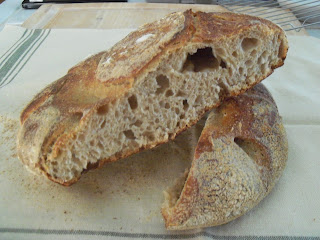
Tight Crumb
However, the crumb did have a wonderful gelatinized structure and it was moist and delicious.
Cool picture of the crumb
I highly suggest making this bread and the crumb structure will be a lot better if you don't make mistakes :)

Second, I messed up on the shaping of the two batards. At first, I thought that I had underproofed the dough, but I quickly realized that I had not when the boule came out fine. This is what happens when you don't shape a batard well. Seriously, I need lessons. Advice anyone?
Comparison of the two loaves
Even the less pretty one will taste delicious.

Tasting Note 02/18/13: This bread makes some of the best toast that I have ever tasted. Toasting brings out the barley sweetness of the bread creating an amazing depth of flavor with the warm wheaty taste. Seriously delicious. You will not regret making this bread, I promise. I'm so excited that I have two more loaves of this in my freezer!

I am submitting this to Yeast Spotting.

Monday, April 2, 2012

Bread: Back After a Short Respite

Spirally Loaf!
So I have been on a bit of a bread hiatus because of finals and then not being home much over spring break because I was catching up with friends. I am really sad that a lot of these people are going off to different places at the end of this year. But I will enjoy the time that is left. Anyway, I made up for it by making some loaves yesterday. I baked the first three this morning and will bake the last two this afternoon.
Three Loaves: Norwich More-Sourdough

The first three were Susan from Wild Yeast's Norwich More-Sourdough with some modifications:
  • I used about 75% whole wheat sourdough starter (just using what I had around)
  • I substituted course-ground whole wheat for the course-ground rye
  • I added about 50g water (up to 610g) and then splashed in a little extra when the Kitchen Aid didn't seem to like the stiff dough, so maybe up to 640g all together.
  • I added in 40g of wheat germ and 10g oat bran
  • I also readjusted the timing, because the temperature in my kitchen is 70 degrees F instead of 76 degrees F.
  • I added one extra stretch-and-fold during the bulk fermentation
This set of loaves is magically delicious. Maybe it's just because I haven't had homemade bread in two weeks. Feast your eyes. More to come...
Spirally loaf (Loaf #1)
Loaf #2
Loaf #2
Crumb of Loaf #1, tight but not bad.
Loaf #3 (scoring experiment)
I am hosting my next bread lesson this Saturday. I think we are going to make spelt ciabatta, pumpernickel, and croissants. Yum!

Friday, December 30, 2011

Dry(ish) Dough Success

I made a version of Wild Yeast's Norwich More Sour Sourdough again. I was determined to get it right this time. So I only added 35 grams of water extra. I mixed it together with the normal head on the Kitchen Aid instead of the dough hook and saved the dough hook for kneading process. However, the Kitchen Aid seemed to be having a lot of trouble kneading the dough so I added another 50g of water and it seemed to work out much better.
Loaf One
I've noticed I have an impossible time walking away from the Kitchen Aid while it's mixing or kneading. I like that it doesn't make a mess, but I just feel like I can't leave the baking process. I guess old habits are hard to break.
Loafs Two and Three
The bread turned out beautifully. Really stunning. My only complaint is that it tastes a little more like store-bought bread than my usually fare. Obviously it's much fresher than it would be in a store and no commercial yeast and a little added whole wheat for flavor, but it doesn't have the same depth of flavor that for example the Tartine Loaf has or even that of my own easy sourdough.
Loaf and Mini Loaf
I also made a couple of the mini loaves (see above and below). They were silly but really cute.

Happy Holidays!

Thursday, September 1, 2011

Bread: Some Thoughts

Yay Bread!
It was finally cool enough to make some bread today and my sourdough starter was begging to be used, so I made some bread while I wrote the first draft of my paper on the Parthenon Frieze.

So it may not be my prettiest loaf, but it was quite a success. I took it out of the oven and it was light as a feather, which means that it actually worked. I have had little success with this recipe, Norwich More Sour Sourdough from Wild Yeast, and this is the first one that turned out perfectly I scored it with the new beautiful lame that I got for my birthday. It was hard to use because the blade was curved and I wasn't used to it, but it made a beautiful ear on the bread.
The Ear
The crust sang beautifully. It crackled nicely when I bit into it and looked lovely, although I might have left it in the oven for a few more minutes. I did change the cooking time. The steaming was 27 minutes and the crisping was 10 minutes (took out when the internal temperature reached 212 degrees F).
Crumb
The bread was fabulously flavorful. 75g of the starter I used were whole wheat in order to increase the flavor and it was miraculous and I increased the hydration percentage to 78% instead of 68% in the original recipe. Unfortunately this meant that I did not develop quite the interior crumb that I wanted, but it still was nice and airy on the inside. Yum!

I did realize that I may need to recalibrate my thermometer that I use to check whether the bread is ready after reading a blogpost today, but I will just have to do that before the next loaf.

Note 09/02/11: We finished off the first loaf today. Further in the crumb looked a bit better.

When I made this loaf, I made a second one which I putin the refrigerator for 16 hours. Servia cooked it while Propertius II and I talked about the beginning of Iliad Book 14. She slashed it in the shape of a sun and I thought it was very cute.

The differences between the two: 1) both had flavor, the cold fermentation loaf was more sour a and a little more flavorful but a little less wheaty. 2) I baked the cold fermenation one slightly longer: 30 minutes under steam (because it came right out of the refridgerator) and 10 minutes crisping. The crust was a little thinner and it was more crispy than crunchy. Still lovely. 3) The crumb was better on cold fermentation. 4) There was less oven spring on cold fermentation.
Servia's Sun
Cold Fermentation Crumb