Showing posts with label Reading. Show all posts

Saturday, June 18, 2011

Reading vs. Speaking

 Jannach's German for Reading Knowledge
I am taking a German class for graduate students this summer (starting Monday) in order to prepare me for graduate school. Any graduate program in classics will require translation exams in (usually two) modern languages. Much classical scholarship appears in Greek and French. I need this not only to pass the exam but to also look like a serious candidate for a department. On Stanford's website they say: "Modern languages are needed, too--as part of your professional development, you will have to pass a German translation exam plus one in French, Italian or modern Greek, and there is very little time in graduate school to learn these languages from scratch" (Classics department website).

I had five years of what I might call "tourist French" over the course of middle school and high school. It was basically useless. I can mostly understand basic French when it is spoken to me at a moderate pace and read very very basic short pieces (with a dictionary), but I can neither write nor speak with any skill whatsoever (other than asking for directions to the nearest bakery or similar). I have spent a little bit of time over the past week attempting to revive my French. It is going to be a hard slog, but it appears that learning Latin has made French a little easier.

My class this summer will take me through the process of learning how to read and translate German, with little to no emphasis on speaking. In general, I'm pretty excited. Even the practice sentences in the textbook are more interesting than any modern language textbook I have ever seen (mostly basic assertions of fact about famous physicists and philosophers). But I do have that nagging feeling: what if I actually need or want to talk to someone in German at some point? Have I chosen the wrong path?

The rational answer is probably not. I can always learn to speak (at least to people in my own field) once I build a technical vocabulary and I will far prefer reading scholarly texts than anything else I might read in a basic introduction. Plus, it's what I need for graduate school. I think I made the right choice.

Tuesday, June 7, 2011

Primordial Musings

Yesterday, I read an incredible article on jellyfish in the New York Times. I realized that they were a primitive life form, but I had no idea that they were three times older than the first dinosaurs and had survived five mass extinctions. The article is quite fabulous and I highly suggest it to anyone interested at all in marine biology.

Infinite Summer: This is my fourth (?) day of Infinite Jest, and I still have little good to say about it. I feel slightly less in the dark than before because some of the characters have been given names instead of obscure nicknames which makes them significantly more identifiable. My greatest compliment for it is that it is is more articulate and sophisticated in verbal style than the stories to which I have been comparing it (Oy, The Dogfish Series), but, on the other hand, "The Dogfish who Swallowed the Universe" was written by a twelve-year-old.

Speaking of primordial, I reread "The Dogfish who Swallowed the Universe" today, after my Infinite Jest allotment. I realized that I glamorized the story significantly because I spent so many hours of my formative youth arguing over it [1] with it's author (who, for convenience, I will refer to as Sockhead [2]). I was even inspired to write a similar work of my own around the same age that was a historical and religious parody instead of a social commentary. However, there is still a life and a humor in it that is not only precocious, but still holds up to this day.

"So it was that a cluster of naive lunatics met in a pub" (DSU. 1) and the story is off describing each of the characters. I wanted to quote one of the funniest sections, but most of them require references from earlier in the work to make sense or included a set up that was simply more than I wanted to type out. One vignette-like struck me as amusing. It lacks the subtlety and humor of other scenes (in fact it isn't particularly funny) and the writing lacks a degree of verbal artistry built up in the sequels "Hell Heck" and "Trousers," but in a stand-alone moment it provided a snapshot of the staccato absurdest style that reminds me of Infinite Jest.
"We decided to walk to a place we had sighted on the way to the inn, two or three blocks away. It was a Liberian fast-good pub called Ye Olde Liberian Fast-Food Pub. All of the rooms had themes. Our table was in the "fluffy fire-hose room." Our waiter looked like a cross between a stereotypical caffeine-addict and a stereotypical boy scout. He introduced himself as John and promptly died. I guess Abilio Manuel Guerra Junqueiro was correct. The manager said our waiter was under some stress because there had been a lot of complaints directed toward him. When I asked why, he said that John was more than a waiter; he was also a curator. He curated the rooms. He was criticized for putting stratified rocks in the ocean room. He thought that all stratified rocks came from the ocean. I guess he trusted Abraham Gottlob Werner's theories too much." (DSU 6).
Maybe my problem is that as much as I appreciate parts of Infinite Jest, I find it rather joyless and have not laughed or even cracked a smile at those things which I believe are supposed to be funny. While silly and unrefined, I found myself smiling and laughing at "The Dogfish who Swallowed the Universe." I am certainly a proponent of dark humor, but joyless humor seems like an oxymoron.

Endnotes
  1. The story at once a bizarre fantasy, an exercise in humor, and a social parody of our social group. Any understanding of social dynamics I possess came from discussing, nitpicking, and expanding the social commentary from this book. My interests in social dynamics became so focused that in "Hell Heck" (the second story) my character was described thus: "Gruiforms had sort of become a "watcher." She merely watched (and watched and watched)" (HH 2). Obviously, my opinions are skewed.
  2. At the time when this story was written, the author of the story constantly wore an eccentric gray beanie (for lack of a better term) which, when not being worn, looked a bit like a sock. This vague resemblance caused the author to refer to himself as "Sockhead" when some pseudonym was required.

Friday, May 20, 2011

Book Review: Life From Scratch

I downloaded Life from Scratch for free from Amazon a few days ago. After reading a couple of scholarly article on the last exam I proctored, I decided to switch to something lighter. It was a quick and easy read. I finished it in a total of 3-4 hours.
Life From Scratch
I started reading the book in the first place because I thought the idea of resurrecting a life through cooking (kind of like I did-- although i did mine by Sparkpeople with exercise and healthy cooking) sounded interesting to me-- I did not look closely enough to realize that it was not a true story. However, I quickly realized the story was fictional (due to timeline irregularities). In general, it was a vapid account of two-dimensional characters that ended in a totally unrealistic and trite manner. I would not particularly recommend it.

Friday, December 31, 2010

An Uncertain Masterwork

I am apprehensive to write a review of The End of the Affair. This discomfort occurs for two reasons: first, although I found it extremely powerful and engrossing, I am not quite sure what to make of it, and second, it provides a contemplation of the Catholic faith on which I hesitate and have little ground to judge it. So, as usual, I will give it a partial review, but I would be happy to discuss it with anyone who has read it.
The End of the Affair (Penguin Classics Deluxe Edition)
I cannot remember who recommended The End of the Affair to me, but the recommendation (and subsequent purchase of the book) came sometime in my senior year of high school. That year, like everyone, I spent a lot of time writing college application essays as well as trying to improve my general approach toward writing. Over and over I heard the mantra "show me, don't tell me." This, of course, referred to the ability to convey meaning not through simply passing along information to the audience, but causing them to see, to hear, or to feel your meaning through literary devices. The End of the Affair, and the opening especially, does precisely the opposite; the narrator tells, showing almost nothing. At the time, I put the book down, annoyed at what I deemed to be "bad writing." However, something must have struck me, because a few years later I opened one of the many partial novels I have written with a similar style [1].

About a week ago, I happened upon The End of the Affair when I was looking for a moderately short piece of fiction to read. As I reread the first few chapters, the writing style took on new meaning. The narrator was a mid-level late 1930s-early 1940s author just on the verge of becoming popular; the "tell not show" style made a lot of sense. This narrative style also provided something that I think is really artful: it gave me, as a reader, the sense that the perception of the world that the narrator related was flawed without showing what exactly was flawed about it. There were moments where I cold peer around Maurice Bendrix (the narrator), but most of the time I felt like I was wearing Bendrix-colored glasses-- forced to see the world through his eyes.

(Small spoiler alert for the next few paragraphs)

The story itself is about Bendrix's quest to make sense of an affair he had with the wife of a friend, which Sarah (the woman in question) had ended abruptly without explanation. The story begins as Bendrix's story, the record of his hate, as he calls it, but it quickly morphs into Sarah's story. To me, The End of the Affair was much like The Awakening or "To Room 19" told from the other side, i.e. the perspective of the lover or someone else watching the social forces that lead to the trapped woman's ultimate destruction. In this case, it is not simply social forces, but also religious forces that lead to Sarah's demise. Her desire to be Catholic overwhelms her with guilt for her affairs and for her love for a man other than her husband and self-hatred and ultimately destroys her.

Whether Greene attempts to redeem the Catholic faith in the novel, I cannot tell. Some potentially miraculous things happen, but my interpretation of these events might be either (or both) atypical or against the grain of message one is supposed to gain from the story. You must determine for yourself. The book is engrossing and fascinating. It's also short, so it is well worth the time one would invest in it. I recommend it.

Endnotes
  1. Amusingly enough, this was not intentional. I did not realize my imitation until I reread the beginning of The End of the Affair.

Thursday, December 30, 2010

Fiction: The End of the Affair

I just finished Graham Green's The End of the Affair. Although I will write a review, I must finish reacquainting myself with the Μήδεια passage I am going over tonight.

Wednesday, December 15, 2010

Time Worms

Last night I spent most of the night helping my friend out with her Sartre paper. I have never read any Sartre. She simply needed a sounding board for ideas and someone to help crystalize her thoughts into a more coherent form. Although it may not seem like it sometimes on this blog, I do have some talent for extracting the essence of and repackaging thoughts. We spent a long time on the phone and then on skype-chat trying to figure it out.

Although I do not miss the stress and horror of finals week, I miss the intense discussions it created between students. Most of my friends who are still in school have this crazed vibrancy about them. Staying up late last night to talk over this existentialist work reminded me of some of the reasons that I like academia. That rush of excitement over suddenly comprehending something, phrasing a sentence artfully, or writing something both for a class and because it is fulfilling is fabulous. I am not a fan of existentialism, so far as I know, but I enjoyed the process nonetheless.
Nausea Being and Nothingness: A Phenomenological Essay on Ontology Being and Time
In my senior year of college, I started a group reading the first half of Being and Time. Although I had little time to spend on it and I probably should not have started it in the first place, the group of people who came (including the wonderful Ovid II) were wonderful and the discussions were fun and productive. I did not read Heidegger nearly as closely as I should have, and I would like to try reading it again sometime in the next two years. Hopefully soon (even my Greek history reading and my Horace has fallen by the way-side a bit). One of the things that someone mentioned was that Jean-Paul Sartre's Being and Nothingness, which I was given a few years ago, was considered "a brilliant misunderstanding of Heidegger's Being and Time" and I am very excited to read it at some point.

I have more Μήδεια to read tonight, which is one of the fun things that I've been doing with old friends from my Alma Mater. However, it's much less fun to read Greek when I'm sick because my brain does not process it very well (and I hate that I'm still sick).

Wednesday, September 22, 2010

But for Want of a Good Coffee Shop...

I love working in coffee shops. In my mind, they provide the perfect environment because:
  1. You're not disturbed, but you're also not alone (which can impede work because all you want to do is go and find people to avoid it).
  2. There is coffee which increases both comfort and productivity
  3. If you are hungry, there is usually food. The food costs money, so it dissuades you from eating to avoid your work, but you also know it's there if you need it so you cannot use the excuse about needing to go get food.
  4. The white noise of music or conversation is there for you, but you can easily drown it out with your own music.
  5. You look super cool sitting there with a scholarly book, math/science problem sets, classical poetry and a dictionary, etc
  6. There might be interesting people there to notice if you need a moment of a distraction before you get back to work, and you don't look like you're paying attention to them, because you're working
  7. Every good coffee shop has its own unique appeal.
I rarely went to the campus coffee shops when I was at school. The coffee was pretty great, but unfortunately I knew a lot of people who went there and worked there, which caused it to violate my first benefit of coffee shops (listed above). So instead, I used to walk about 0.8mi to my favorite coffee shop.

The shop had one long window that face the street so that the light came in and a person sitting in the chairs could see people walking by. For people-watchers like me, this was an ideal place. The coffee was generally of good quality and their multi-grain bagels were phenomenal. I used to just sit their for hours, working on my thesis or reading for one of my other classes.

The best thing about the coffee shop was the people. The baristas were lovely; they had nice senses of humor,  and they were young, friendly, and liberal. The population of the coffee shop was mostly made up of senior citizens-- most of whom had a strong christian background. The coffee shop was located in a predominantly christian neighborhood; there were seven churches in all within a three block radius of the shop. They had coffee every day. Because of the routine, they knew each other well and spent long hours drinking coffee and talking about their various childhoods as each were raised in different christian sects. There were even a christian quilting group that met there. There was also another group. There was a young web-designer, also a regular, with her dreadlocked-hair, her vulcan eyebrows, her homemade clothes, and her energetic seven-year old son. On the weekends, there were also a number of fathers with daughters and sons, often giving the children's mothers and hour or so of quiet time. And, of course, there were college students from my school and others the area. What was pleasantly surprising was the friendly ease with which the two groups interacted: the young liberal quasi-hippies and the old, christian conservatives. I do not think I have ever seen opposed groups at such peace and so pleasantly enjoying the company of one another.

I felt so at home there. I remember coming in with my laurels-- a display that I had fninished my thesis-- and one of the barristas asked what the occasion was. When I told them I had finished my thesis, the whole coffee shop applauded. It was so lovely. Then I enjoyed my coffee and bagel while reading for one of my last classes.

Unfortunately, since I moved, I do not have a new coffee shop in which I can translate. I really miss that atmosphere. There are three in the area that I have thus far discovered: one is too noisy, one is too sketchy, and one has these horrible aluminum tables that make a loud banging noise every time someone sitting at them moves. The search continues.

Sunday, September 19, 2010

Grad School: The Reading List

One of the things that most classics grad programs (e.g. Berkeley, U of Toronto) seem to require from their applicants is a reading list of texts read in the original language. Presumably this is because classes are not standardized at different schools, and this replaces what might once have been a list of classes. I have read quite a few texts in their original language-- especially Greek texts. Some of these texts, given when I read them, I read or remember better than others. However, Berkeley's list was a little different. It gave examples of what it considered to be second and third year classes, and expected two more semesters on top of that. This was fine in principle, but the texts they provided as examples were kind of scary.
  • Homer (3-4 books)  I haven't read Homer since highschool, and I only read Book I of the Iliad.
  • Plato (1 short dialogue) I read the Phaedrus which is much harder than most of the short dialogues (although I have to admit, I had a lot of trouble with it) plus selections of a number of other Plato's texts.
  • A complete Greek Drama I read the Bacchae back my freshman year, which was awesome, but a long time ago and I think it would be a lot easier to go back over it now. I also read about 90% of the Agamemnon.
  • Aeneid (3-4 books) I read Book 8, and excerps from books 10 and 12 in my second year Latin class, but still, obviously not enough.
  • Republican Prose (40-50 pages) Pro Caelio and selections from Caesar's Civil Wars, which I would think add up to about 40 or so pages.
  • Horace (30 poems) none until yesterday-- and I read I.1, 5, 9.
My lovely friend Propertius II and I went over my readings of I.1 and 5 today, during which I think I enjoyed the poetry much better than the first time that I read it. It is so nice to have another classicist who is willing to patiently work and discuss with me (as well as provide, at least in theory, some mutual benefit because he has not read much Horace either).

However much I am enjoying my grad school prep, at least at the moment, I am already behind. The timeline that Princeton Review puts out really scared me. I am so behind.

At an alumni dinner tonight I met a lovely classics grad who is getting his PhD working on Homer. I only hope that I can get into grad school and move things forward in the direction that he did. I hope also that I can live up to my own expectations bot in getting into and doing well in graduate school.

Saturday, September 18, 2010

Teaching through the Invisible Wall

I proctored another practice test today. Practice tests are a long four hours and I finished Genres in Dialogue: Plato and the Construct of Philosophy and was able to cross it off of my reading list [1]. I also read two other works which I will discuss in detail over the next few days.

At one of the five-minute breaks in the four-hour exam, I asked my students how their college applications were going. People were nervous-- and rightfully so-- but were in the process. I told them that I was doing graduate school applications, and they were a nightmare because they do not have a common application and require a lot of strange GPA manipulations (depending upon whether the school is focused on your grades in courses in your major, in your last two years, etc). After explaining this, I realized that this attempt to explain my sympathies with the students' situation was precisely the wrong approach. They do not want to hear how hard my experience is-- or the things that may be awaiting them after college-- but rather they would like some encouraging words.

I always thought, while I was in high school, that when I became a teacher (I wanted to be a professor of course, but I figured that it was a similar principle) that I would understand the plight of the student and not be alienated from it in the way that my teachers seemed to be. My specific specific qualms were with busy-work, "creative projects" as graded material, and improper balancing of review and new material (in either direction). Now, I realize that there is as much of an invisible wall between my students and me as there was between me and my teachers. Maybe it is the inevitable position of being a teacher.

One thing that cheered me up was an essay that a student wrote today. The topic asked the students to consider what type of learning should be done in schools. One of the girls related a personal anecdote about a friend of hers sitting at lunch one day and complaining that school did not have enough breaks and did not incorporate enough creative learning. The girl questioned her friend, and through questioning the friend agreed that although it might feel that way, but the purpose of school was to provide a learning experience and that it was ultimately useful. I do not know if the anecdote was true, but it made me feel a little bit better.

Endnotes
  1. Genres in Dialogue: Plato and the Construct of Philosophy is fabulous. Andrea Nightingale utilizes a mixture of history and classical scholarship with Bahktin and a smattering of literary theory to provide an energetically written and scholastically footnoted work that provides a fascinating analysis of Plato and the development of philosophy as a genre. I will do a full review soon.
Genres in Dialogue: Plato and the Construct of Philosophy 

Wednesday, September 15, 2010

Updates: Kindle and Free Books

I wrote two blogposts of the last few weeks which I feel are in need of updating: A Bibliophile's Review of the Kindle DX and Problems With Free Books. (I also recently updated the Blog on the Minoan Octopus Jar.)

Kindle for Cooks
One of the things that I did not mention in my original review is my use of the kindle for cooking. I use it in two ways. One is to download and put recipes on my kindle and stand it up on my counter-top. This only works, obviously if one downloads a cookbook or creates a PDF or MOBI document. I used a particular case, a platform kindle case, that allowed me to stand the kindle upright so that I could read the recipes easily. The other way that I used the kindle was to have it read to me while I was cooking. I downloaded a free version of The History of the Peloponnesian War and had the Kindle read to me while I was cooking so that I did not waste time [1]. It was pretty helpful, except for the pronunciation of the Greek names. For example, Themistocles (the-mist-oo-cleez) was pronounced (the-mis-do-cls). Although the humanoid voices can be kind of annoying, it gets the information across and entertainment can be found by poking fun at it.

Kindle DX Wireless Reading Device, Free 3G, 9.7" Display, Graphite, 3G Works Globally – Latest Generation

As a random technological sidenote, I have had my phone for 6 years and it is finally beginning to break down (people cannot hear me when I answer the phone and I have to shout, etc). Does anyone have a good recommendation?

A Clarification and More Amazing Free Books
I realized that I never explained the meaning of the title "The Problems of Free Books." The idea is that Google Books provides some downloadable free books as well as providing essentially an enormous, no-membership-required digital library that allows the reader to browse through editions of books online for the purposes of research, as well as for the ability to preview books online. For any other book, there is the difficulty of finding the book in the first place, making sure that it is the correct edition, etc. Speaking of free ebooks, there is another Amazing Site (referred to me by Propertius II) that has a bunch of academic books marked "public" which can be read online.


Endnotes
  1. At the time when I was doing this, I was taking a class on Thucydides: Book 1 in Greek, I was attempting to read the rest of Thucydies' History of the Peloponnesian War for context. Usually I would read the beautiful Landmark Edition, which was a wonderful gift from my parents, but I ended up just trying to breeze through the kindle edition, and look at the Landmark for reference.

Friday, September 10, 2010

The Problems with Free Books

This morning, my mother emailed me a thoroughly amusing article called "The Trouble with Google Books." The article deals with the errors and problems that Google books has, specifically with metadata (i.e. the data that allows you to find the book you are looking for, e.g. publication date, author, etc). Some of the pieces are particularly hilarious, such as attributing a book an the Mosiac Web browser to Sigmund Freud's distinguished co-authorship [1]. My biggest problem with google books was that it always omitted exactly those pages of a book that I needed most when I looked something up because some other enterprising classicist had checked it out of the library before I got there [2].

Although I have always been a massive lover of cheap books and used books (which is the only way I could have amassed the massive collection of books around my house and in boxes in the garage), receiving a Kindle (see my previous blogpost) I have become a zealot for free electronic books. Part of the time while Cerinthus was visiting, I stupidly spent showing him the wonders of ACLS Humanities E-Book Archive (because he still has access to our college's server). It is incredible. Although one can only download PDF pages in three pages bursts, there are some fabulous academic texts on every subject from archaeoastronomy to modern urban planning. If one compiles the books oneself, they're free (provided, of course, access to said archive through school or an academic institution). I also have spent a lot of time searching for books, especially classics books and found a number of different places (to many of which I link on Platonic Psychology). Some interesting ones are as follows:
  • Project Gutenberg: An archive of out of print books and audiobooks. Has a pretty awesome variety of formats available, including MOBI documents for the kindle. They are now also compiling audiobooks, as well as adding works in their original languages, such as Greek and Latin (as well as German, French, etc)
  • Internet Archive: Very much like Project Gutenberg, this archive includes a variety of out of print books in many different formats, including the Sanskrit Grammar that I included in my blogpost last night.
  • Textkit: A selections of out of print materials for teaching Classical Greek and Latin.
  • Free Books from Amazon: this is all in kindle format (but can be read with free kindle reading apps), but it includes out of print books, as well as government documents like the U.S. Budget, and a number of new studies on digital media and learning by MIT, like this one.
There are some more but this is a start and I would love to hear about more I have not found yet.

Harping on my education theme, again (sorry!), I think cheap used books and free ebooks are awesome. I believe, most certainly, that authors and the institutions who aid in dissemination their work should be paid and that they provide a vital service for society. However, the library near my house has a book section only twice the size of my bedroom. Thus far, I found no classics texts there I am interested in reading. The books are simply too expensive for a small local library. It seems to me that libraries are one of the great places that one can supplement or design their own education. It makes no sense that only university libraries have the necessary academic texts when cities and towns without universities are the ones could most use an extensive library. So I think that used book sites and free ebooks are great because they provide access to a whole range of materials not otherwise available.

Endnotes
  1. This reminded me of when I asked a group of my SAT kids what they knew about Charles Dickens' writing, and I got three blank stares and a girl who told me that she had only read half of Alice in Wonderland and did not remember it very well. I was also shocked to learn that out of a 13 person class, not one person knew who Adam Smith was. On the other hand, every one of them can work a smartphone, an art which I have not yet mastered.
  2. My junior year this was a particularly pernicious trend, which prevented me from ever getting a chance to read Genres in Dialogue for my Phaedrus paper. Luckily, I received a copy for my last birthday and I am enjoying it thoroughly.

Monday, September 6, 2010

A Bibliophile's Review of the Kindle DX

I have had my wonderful Kindle DX for a year now. It was a wonderful and incredibly useful gift from a close family friend. I think that is ample time to explore the benefits of the Kindle and also to demonstrate that owning an eReader is not going over to the dark side.
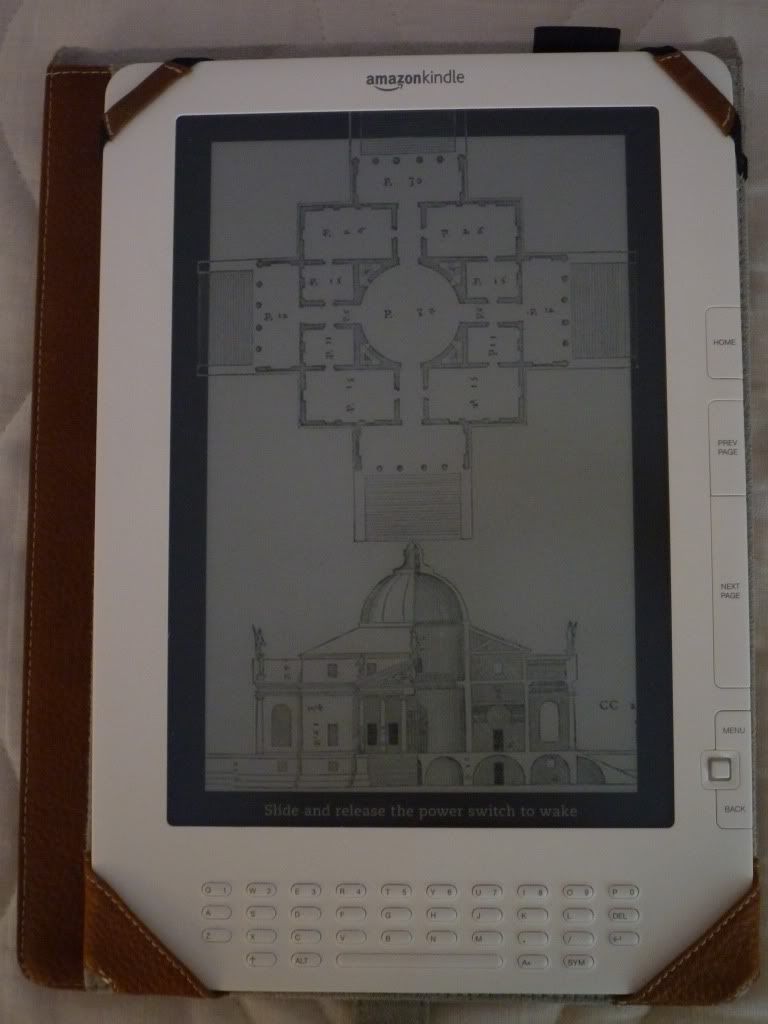
My Kindle DX
As I have mentioned before, I have a visual processing disorder, so reading off of anything (and especially a computer screen) for any length of time is difficult. Unfortunately, like at any university, many of my classes required supplementary readings that were held by online reserves, and had to be read either on a computer screen or by printing them out. Although I read many of them on paper, printing at school, as well as my own printing (with the cost of ink/toner) was expensive. Both of the two doctors who I consulted recommended the Kindle DX to me, because of the e-ink screen and because font size and word spacing are easily changeable, as well as the reading aloud function.

I was very skeptical, at first, of the idea of an electronic reader. I am a serious bibliophile (as presumably anyone can guess from the bookshelf at the top of my blog and my reading list). I love the feel of books in my hands, the tactile sensation of turning the pages and hearing the distinctive sounds of the paper. I love new books, so shiny and perfect one hardly wants to open them. I ordered a copy of Immanuel Kant's Groundwork for the Metaphysics of Morals that releases the distinctive smell of jasmine soap upon opening. I also love used books, a little worn or with an inscription by the previous owner. For one birthday, my parents bought me a copy of Idle Thoughts of an Idle Fellow from the mid 1890s, with a beautiful sky-blue leather cover and accents of gold leaf, a little worn on the spine with use.

However, when I received my Kindle DX, I was almost immediately won over. The device itself is sleek and lightweight (and the new graphite ones are actually even sleeker). I can carry 3,500 books and documents. While I was at school, I no longer had to print, I could do my electronic reserve reading right on my Kindle [1]. Furthermore, I could download any PDF from Jstor or any of the wonderful electronic journal archives for research or pleasure reading and read them or save them for a later date. There are also a ton of free books on Amazon and Project Gutenberg (mobi documents) for the kindle, which can be annotated the same way that a traditional kindle document can.

I also found that writing my thesis, the Kindle was a real lifesaver. One of the primary texts that I used was Plato's Laws. I read the Laws in English, and then read selected sections I needed in the Greek. Much of the time I needed to refer to specific passages that all used the same word or phrase and sometimes either calculate the frequency of those phrases or discuss their placement in the text. Although I used the Thesaurus Linguae Graecae for much of the searching, I also used the kindle search function in the English version in order to expedite certain processes as well as to contain vast annotations on particular passages.

I do have a number of criticisms of the kindle, some of which Amazon has addressed and fixed.
Concerns that Amazon has recently fixed:
  1. No Organization-- The newest software update that I downloaded allows for collections of books, which means that I can organize the books in any way I choose. This is a huge help given how many ebooks I have.
  2. No Zoom-- The newest software update also includes a zoom for PDF documents, which is very helpful.
Concerns Amazon still need to fix:
  1. No way to refer to page numbers from the print edition. I was lucky with Plato, because Plato scholars refer to Stephanus pagination, rather than page numbers from any particular edition. However, this can be a serious issue when writing academic papers. It usually means that one has to check a print edition of the library as well and then cross-reference, which is really lame. It also provides a difficulty in citing pages for class discussion, which is part of why the kindle experimentation program at universities was not a raging success (my school included).
  2. No way to borrow books. This is truly unfortunate. I lend print copies of my books to my friends all the time, and my mother and I frequently both read a book. I don't want to have to lend someone my kindle, because that is lending a portion of my library and it keeps all of my notes. 
  3. The TERRIBLE pronunciation of times and sometimes problematic inflection of the reader. I know, it's difficult to get a computer to pronounce things properly. When I was taking a Thucydides course where we were focusing intently on Book I (in Greek), I would listen to the rest of the book (in English) while I was cooking or cleaning to provide context. I often had to go over and check the text because I could not understand the names and place names to which she was referring (I usually listened to the female voice).
  4. Problematic edition differences. According to an Amazon representative that I talked to once, publishing companies put out their own version of the kindle books rather than Amazon doing it themselves. I understand this principle. However, I cannot understand the lack of standards between different publishers. One of my favorite features of the kindle is linked footnotes, and a lot of books just have endnotes in the back instead of the linked footnotes. It seems like it would be easy to have across-the-board standards for the different companies.

    Overall, the kindle is awesome. I now only have to lug one book and a kindle on a trip, instead of taking 3-4 books with me. I love my kindle so much that I bought a second one off a friend (who got it as a gift and was not a fan) and gave it to my mom, who also loves it.

    If anyone is interested, the case I have is also awesome.

    Update 02/14/11: There are new updates for the kindle. The first two problems (page numbers from the print editions and borrowing books) have now been fixed, although the former has only been solved on certain kindle books and only for the newest editions of the Kindle 6". I discuss this in a recent blogpost. The borrowing books feature is also questionable. The book leaves your kindle and moves to the other person's kindle for either 2 or 3 weeks, and then it returns. Each book can only be lent once. As a person who lends out a lot of books and who is loaned a lot of books, this system seems pretty ridiculous. However, it's better than nothing.

    Endnotes
    1. For anyone interested, any documents that have been scanned with facing pages can be split into two separate documents with your pdf reader/editor program and then merged by alternate pages with PDFsam. This takes a few minutes, but if you do it once a week or so with all of the electronic reserve documents, it really helps. I got this tip from a friend.