Two nights ago I made some pizza for a bunch of friends. The pizza seemed to go better than ever before. I didn't get any pictures (I was making pizza for 8 people and trying to juggle the timing). I learned a number of things that I thought I would share.
The last time I made pizza for 8 people (bread baking day), one of the people I was teaching had worked at a pizzeria for a few years in between undergraduate and graduate school. He taught me how to shape pizza dough so that it has fluffy edge of crust. The method he taught me was to make a circle of finger indentations in a circle about 1-1.25 inches from the edge. Then, stretch the interior of the dough by flipping it from one hand to the other. This is the way that the make the lovely Neapolitan pizza at the pizza place near school. It also is the way that Eric seems to make it in this video. I am looking for another video that might have some better footage of the same technique.
While it has taken me a while to manage this technique (and I still have not mastered it), it turned out a lot better this time. This is the only picture I have. I made too much pizza so I refrigerated this one and I unfortunately only got to take it after it came out of the refrigerator. Also, sadly, this pizza does not have the cheese Egnatius made because we ran out of it. A gallon of milk only makes a small amount of cheese.
Pizza with Heirloom Tomatoes
I also modified my sourdough pizza dough slightly (reflected in the current recipe). I had to make two batches. For the first batch I substituted 90g of semolina for the bread flour. The recipe now reflects this because the flavor was so much nicer. I did this once with fancy grind durum as well and it improved the flavor but I only substituted about 50g that time so it was not the entire flavor revelation. But the semolina really changed the texture and the flavor of the dough. The dough was thin and crispy while still soft on the inside of the edges. It was delicious. I also let the dough sit out for longer during the kneading process and only aged it in the refrigerator for about 6 hours.
The second set of dough that I made, I forgot to make the starter beforehand. Instead, I used some fruity-smelling whole wheat starter that passed the float test (226g to replace the starter). I then compensated for the added whole wheat by making the 50g of whole wheat into bread flour. They were a little heavier, but still delicious.
The party was lovely. Sue and her husband plus Egnatius, another friend from my program, and her sister. The friend from the program brought over a lovely Zinfandel.
I suggest that if you have the chance, try the new version of the pizza dough. It is fantastic. I also used the pizza sauce recipe from Peter Reinhart's Artisan Breads Every Day (p. 70). It was fantastic. Here is a modified version of the recipe (this is the recipe I used):
1 can crushed tomatoes (28oz)
1/4 teaspoon freshly ground white pepper
2 tablespoons fresh basil, roughly chopped
2 teaspoon dried oregano
5 cloves pressed garlic
1 tablespoons red wine vinegar
1 teaspoon salt
I mixed this and simmered it for about 20-25 minutes.
It's been a while since I have made any bread. I haven't had much time. Tomorrow is Servius' birthday so I thought I would make some bread so we could have a picnic lunch on the porch. I am making his favorite: my usual whole wheat Tartine bread with steel cut oats, flax seeds, and sunflower seeds.
While I was making the bread and some pizza dough for tonight, Servia and I were talking about the Harry Potter phenomenon. These last two movies which dramatize book 7 have been theonly two for which we did not attend the midnight showing (and I have not seen the final movie yet). We all have been really busy and book 7 is by a mile my least favorite of the set. Servia mentioned she missed going to the movie, but I really miss the pageantry of the books coming out. Even by the time that the second book came out in Britain (we rush ordered it because it took a lot longer to arrive in the USA), I was old enough to realize that the writing was not particularly good, but I enjoyed the pageantry of the whole thing. When the books came out, Servia and I would make apple pie for Servius as he read the books outloud to us. We drank tea and made plot predictions. Those summers on the porch are some of the happiest moments from my childhood (and beyond) and lining up to get the books at midnight made it seem like this happiness and vigor was widespread. I was considering this afternoon how much I wish there were another equally-appreciated series that would once again have people of every age and personality lined up at book stores all over the world. Maybe someday...
So while we had company here, we decided to make some of my semi-sourdough pizza crust and have everyone add their own toppings. My mom decided to help out, because I was making some other bread at the time. She forgot to measure the water and ended up with what appeared closer to sourdough soup than anything else. We estimate the volume she put in, weighed it, and recalculated the 68% hydration for the dough and estimated the rest. It was about 2.5 times the volume, so instead of making 6 pizzas there was enough dough for about 15. We made the pizzas for dinner-- they went like hotcakes-- and we froze most of the rest of the dough.
Two pieces of dough managed to escape the freezer, so we decided to make some focaccia. Servia got some rosemary from the garden, minced some garlic, and drizzled the bread with olive oil and a little garlic salt. After letting it rise for an hour, we baked the focaccia for 20 minutes in an iron skillet, the first 5 minutes under a pan lid to let it rise sufficiently in the oven. The focaccia seems to have made Servia feel a little bit better. The whole family seems to have come down with a cold or the flu. Even with my clogged sinuses, the roasting garlic smelled great.
I made this pizza a few days ago. It's based closely on Peter Reinhart's "Sourdough Pizza Dough" recipe in Artisan Breads Every Day (Reinhart 69-71). Fair warning: this takes a long time and I had to plan three days in advance. However, I have never had homemade pizza that tastes like this. Simply incredible. I highly recommend it for anyone wanting to make it. I made a few modifications (changing the starter base) and cutting the bread flour with whole wheat flour, but I am sure that the original version is just as good (or probably better) than mine. Here goes:
Mix the starter together in a bowl. Cover in plastic wrap and let sit for 6-8 hours before using or refrigerating. According to Reinhart, it can last for up to 4 days. I used it the next day.
If you refrigerated the starter (like I did), let it sit out for 2 hours before using it in the dough. Dough:
226g of sourdough starter (all of it)
460g unbleached bread flour
50g whole wheat flour 340g lukewarm water (pour in 300, use the last 40 to hydrate the dry active yeast)
1 teaspoon dry active yeast
14g salt
1.5 tablespoons honey
2 tablespoons olive oil
Mix the flour, water, and starter together in a bowl with a dough whisk. Then add the hydrated dry active yeast, salt, honey, and olive oil. Mix again until well blended. Let the dough rest for 5 minutes.
Knead the dough for about three minutes until it begins to feel more like dough than a sticky lumpy mass. Then use the stretch-and-fold technique in the bowl or on an oiled surface: stretch the dough and fold the end closest to you up to meet the top of the dough. Then stretch the top of the dough and fold it back toward you (in half again). Then stretch and fold the left side in so it divides the dough into thirds and stretch and fold the right side in on top of it. Turn the dough over and let sit for 10 minutes and repeat the process. After this second time, repeat the process two more times. The whole process should take 40 minutes.
Split the dough into 5-6 equal pieces and place them in sealable plastic baggies. If you want the pizzas to be large, break it into 3-4 and use larger freezer bags. The put the dough in the refrigerator overnight. They can stay there for up to four days. I used half on the next day and half two days later. The pizza dough seemed exactly the same.
The next day, take the dough out of the refrigerator 90 minutes before you plan to bake. Spray oil on a cookie sheet. With lightly oiled hands, remove any dough you want to use from the bags and roll each piece into a separate ball. Place on the cookie sheet and lightly cover with plastic wrap.
Prepare any toppings that you plan to use. 30 minutes before baking, heat the oven and baking stone to 475 degrees F (you may need to go higher if you have a large oven). Make sure you baking stone is on the bottom-most rack of the oven. This will ensure that your bottom crust is crispy rather than soggy. Our oven is fairly small so if the oven is too hot, things will burn, but so long as the oven stone is as far down as possible, it manages to cook the pizza to perfection.
Just before you are ready to bake, lightly flour your hands begin to stretch the dough. I found the dough to be very stretchy. I was even able to toss it a bit, but it only took about 45 seconds to get each piece of dough into a lovely thin crust. Top the pizzas with whatever you want. I topped three of the pizza's with a heavily-modified version of Lisa Rayner's Pizza Sauce (Rayner 101) [1], part-slim mozzarella, and fresh basil. I stretched the last one less thin and coated it lightly with olive oil and sprinkled it with garlic salt and fresh rosemary. It made fantastic mock-foccacia.
On the peel.
With homemade sauce.
With mozzarella and basil
Load the pizza into the oven with the pizza peel. Let cook for four minutes. Turn the pizza so it is facing the opposite direction. Cook for 3-4 more minutes. Then your pizza is ready to eat.
Out of the oven after 8 minutes. Amazing.
Endnotes
I ended up heavily modifying the pizza sauce because it was way too thick and flavorless for my taste (and I hate fennel). I will try Reinhart's sauce next time (Reinhart 70).
Today (and yesterday's) baking experiment was a learning experience, to be sure. The Reinhart ciabatta turned out well with a few small problems while the Rayner pizza dough turned out poorly with a minor upside. First, the bad news, then the good news.
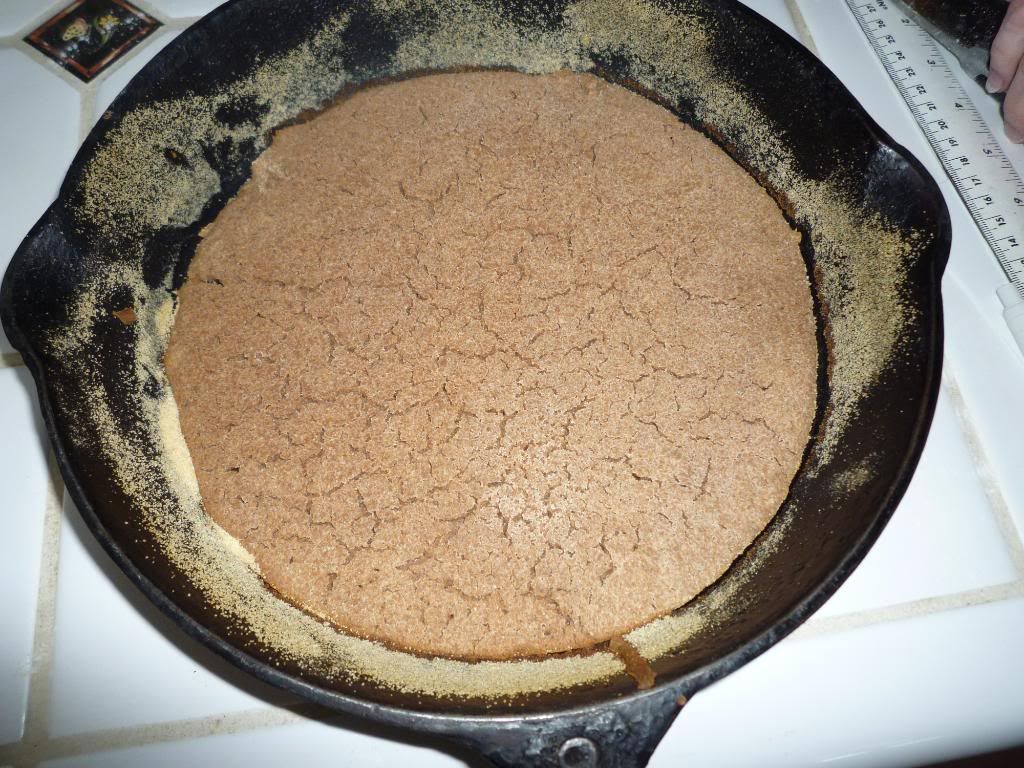
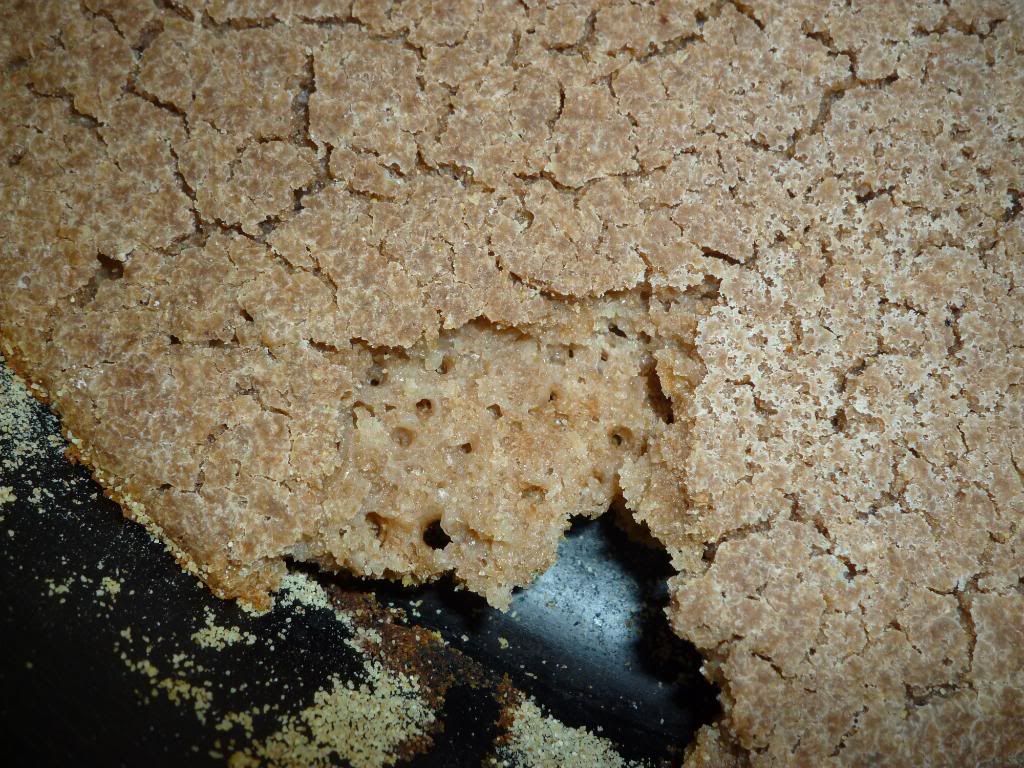
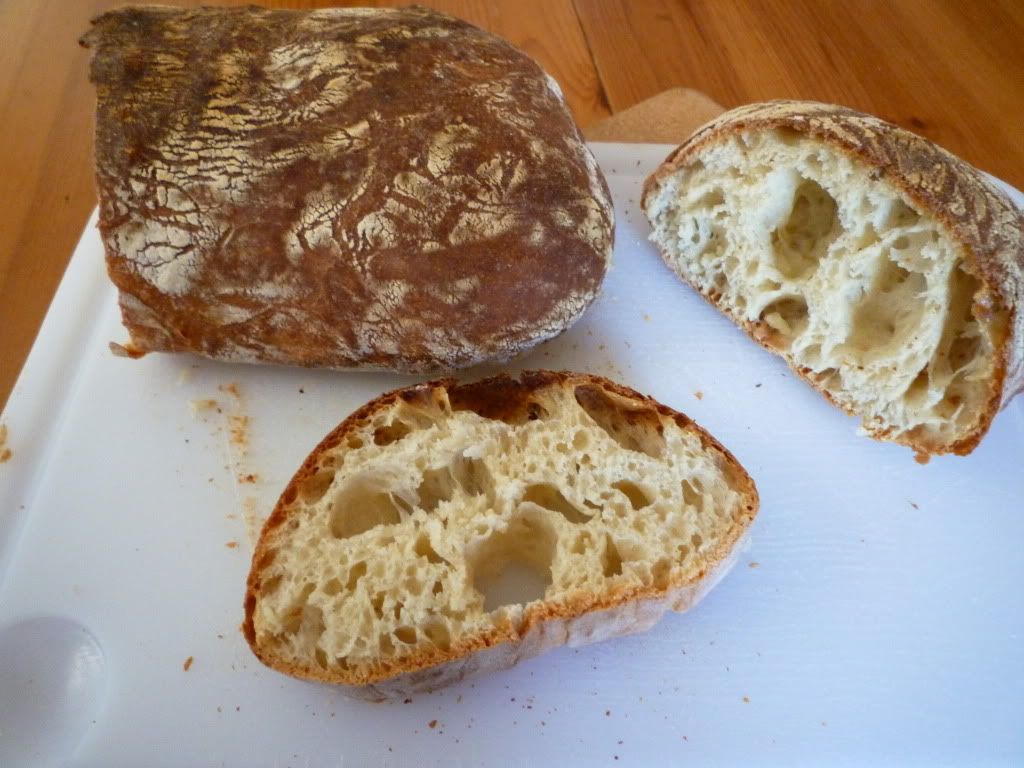
Pizza Goup: Well, no matter what we did, it did not rise. I cooked it anyway. It was flat as a pancake and once it began cracking and looking like the Sahara desert. When I broke it open I was surprised: the bread inside had a light and bubbly crumb (although it was severely underdone because I was afraid to keep it in the oven any longer). I nibbled at the edge, which was cooked. It was actually good! Since I let it sit overnight, it was very sour, but I liked it. I think I might up the salt from 1.8% to 2% if I make it again and I will actually try to make it rise.
Pizza Goup: Out of the oven.
Pizza Goup: the crumb.
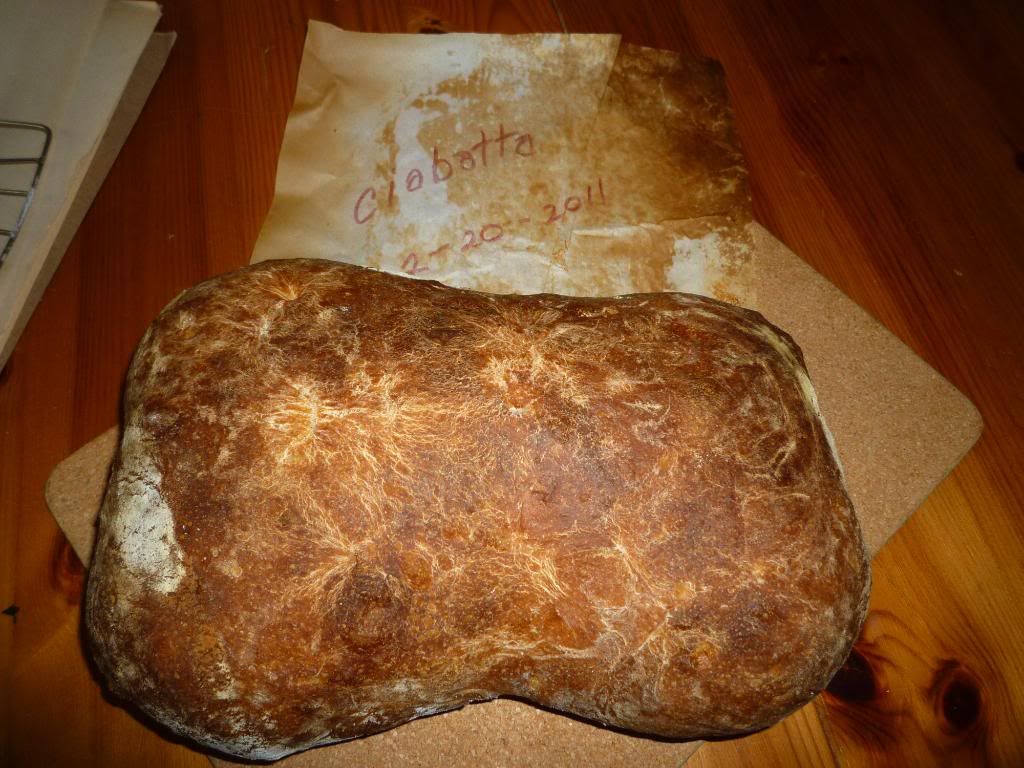
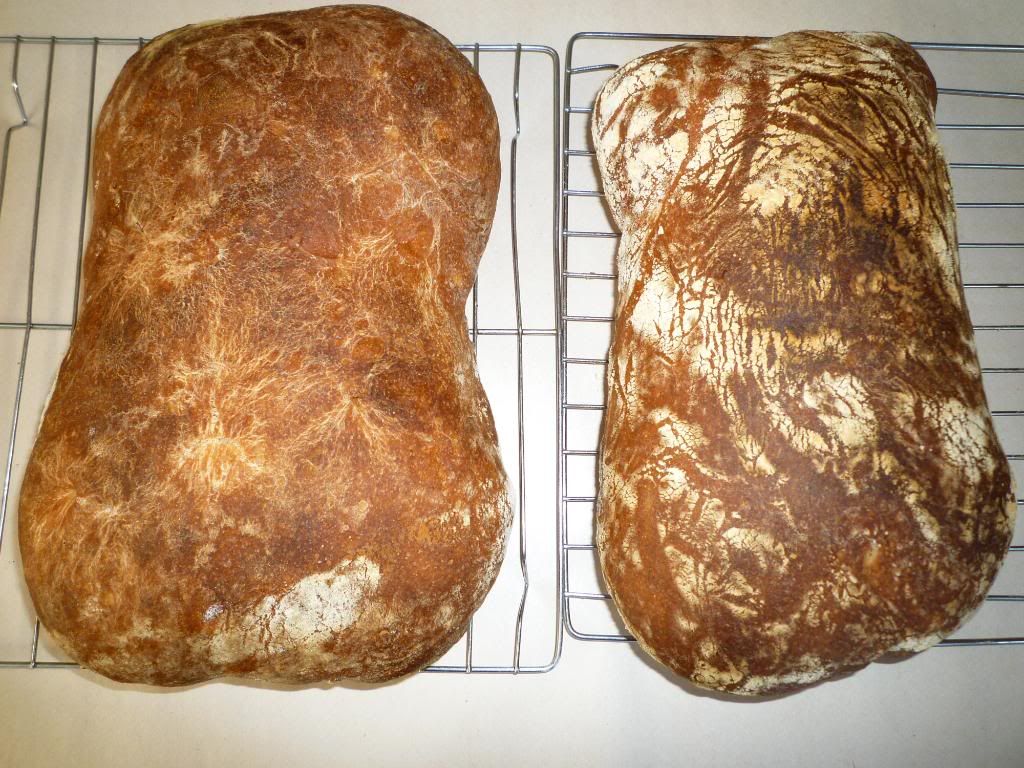
Ciabatta: The ciabatta from Artisan Breads Every Day, despite my hesitation, came out beautifully. I did an experiment: I did one of on parchment paper as Reinhart suggests and placed one of the loaves on the pizza peel in my traditional style. I have decided there is no reason to use the parchment paper except maybe for the first proof. I also realized that every oven is different. At least for my oven, the turning the oven to 525 degrees F (our highest setting) before turning it down to the 450 degrees F baking temperature is a terrible idea (Reinhart 54). The bread had beautiful oven spring, but after the first 12 minutes it almost immediately began to burn. After another few minutes I turned it down to 350 degrees F and
after another minute or too tented the bread with aluminum foil to prevent it from burning further. My suggestion is that if you have an oven like mine (and are using an oven stone) just heat the stone up to 450 degrees F. That being said, the bread still turned out extremely well.
The larger loaf, rising for the 3rd time.
The slightly smaller loaf rising on the pizza peel.
The two loves, out of the oven.
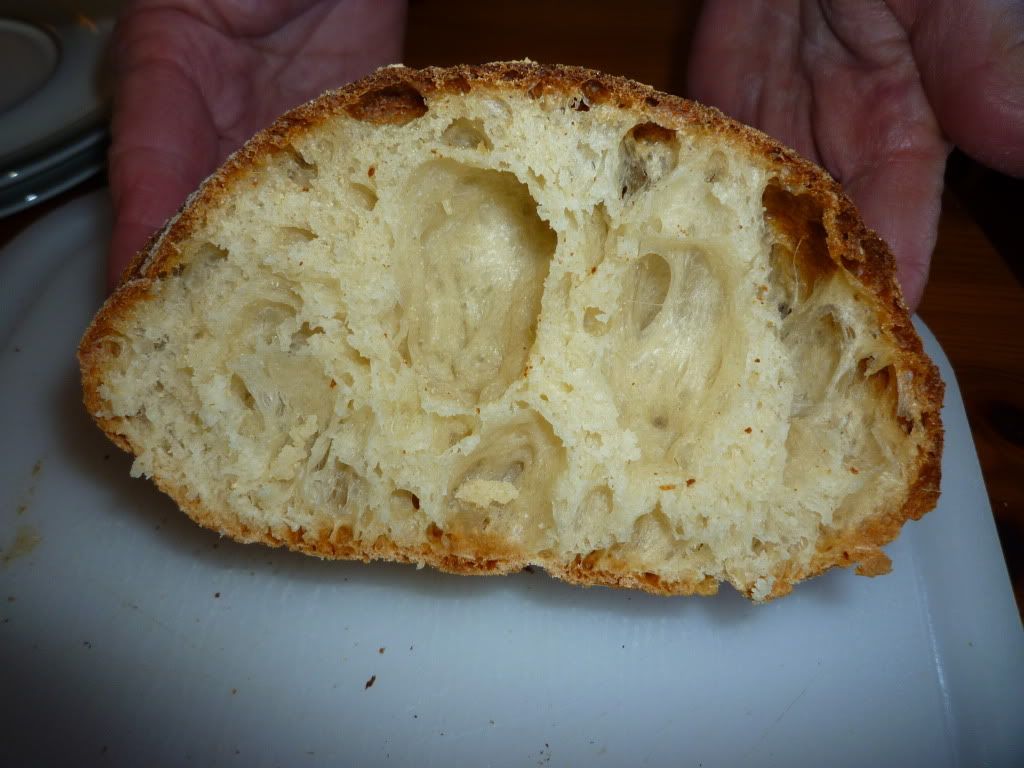
A nice, open, irregular crumb.
Crust and crumb!
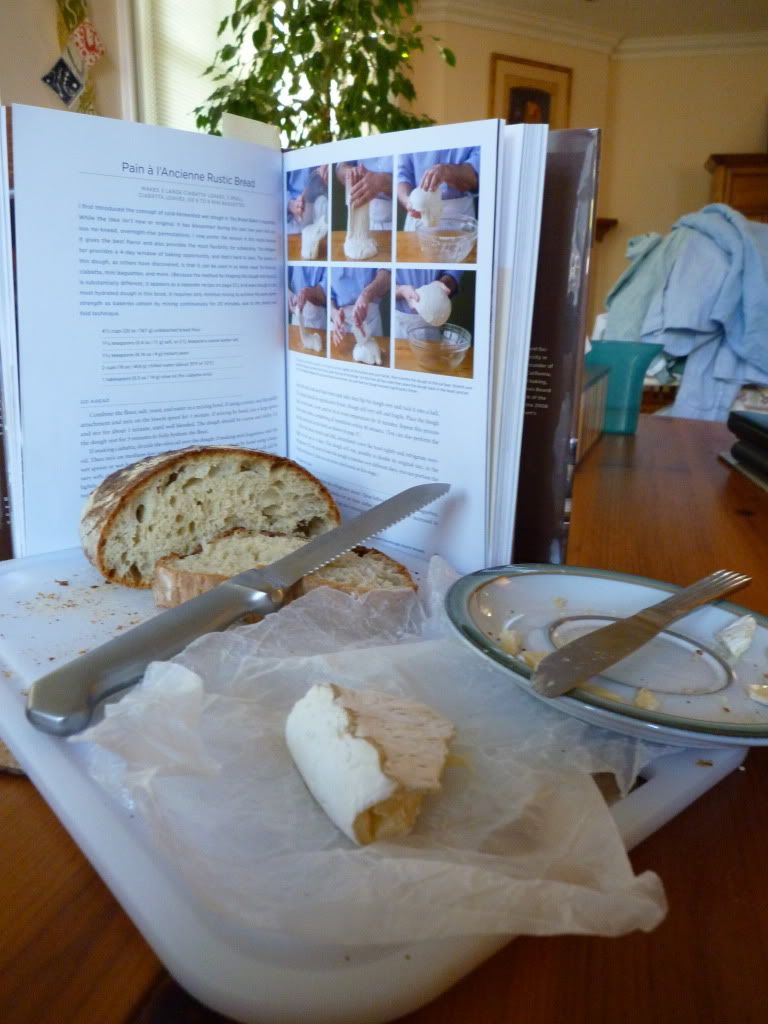
The Aftermath.
It was lovely. I ended up eating more of it than I intended so it was lucky that I did not have much lunch. If you can get a hold of the book, this is a recipe I would highly recommend, especially with brie, a creamy soup, or as the bread for a sandwich.
I have the updates from yesterday's baking log: not promising, but not without hope either.
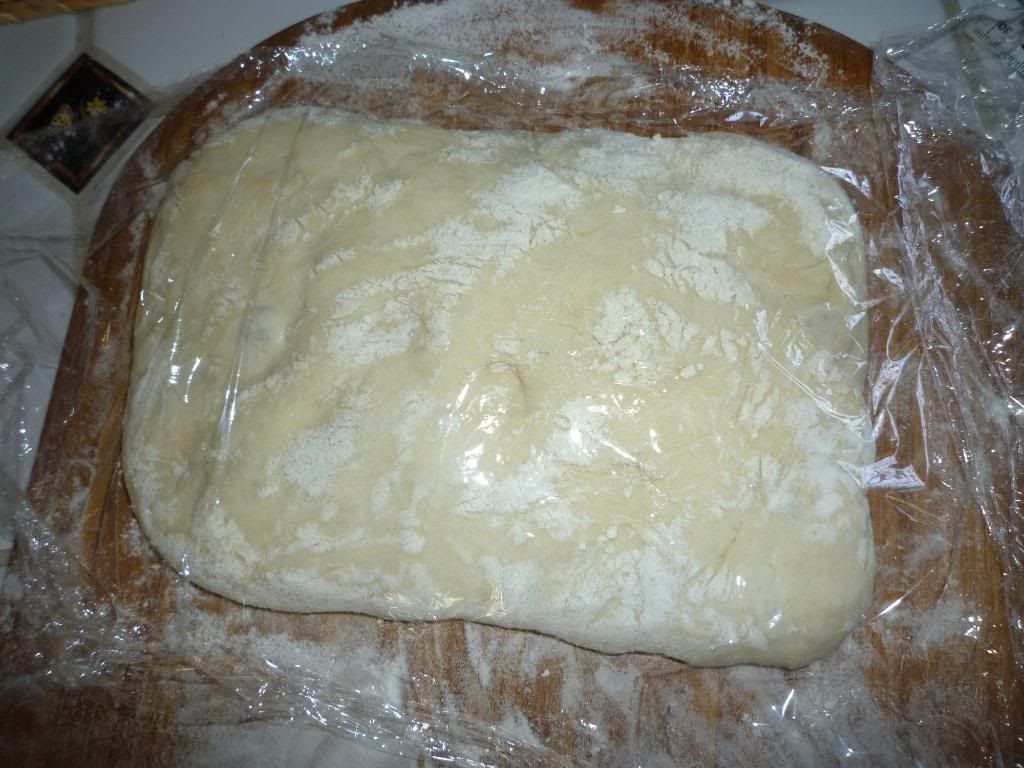
Ciabatta: The ciabatta has tripled in size. I am not kidding. I unfortunately don't have a picture of the original for comparison (clearly I don't have real foodblogging chops) but I have the doubled and the tripled photos:
Doubled in size.
and compare...
Tripled in size.
Now under normal circumstances this would be a cause for celebration. Bread rose, right? It must be good. There are two reasons why I am hesitant. First, this is a baker's yeast recipe. Obvious things with baker's yeast should rise, but over-proofed goods with baker's yeast taste terrible. I obviously can't tell if it is overproofed, but I know that our refrigerator temperature might not be quite as cold or might fluctuate (the refrigerator is a good work-horse, but very old), which may mean that the yeast was not slowed down as much as necessary for Reinhart's cold fermentation process requires. Second, I made one of Reinhart's breads from his book Whole Grain Breads: New Techniques, Extraordinary Flavor [1] and it had the same Frankenstein properties, and turned out over-proofed, yeasty, and with dense crumb despite it's original swelling. On the other hand, I did not know nearly as much about bread as I do now, so maybe I will get lucky and this bread will turn out fine.
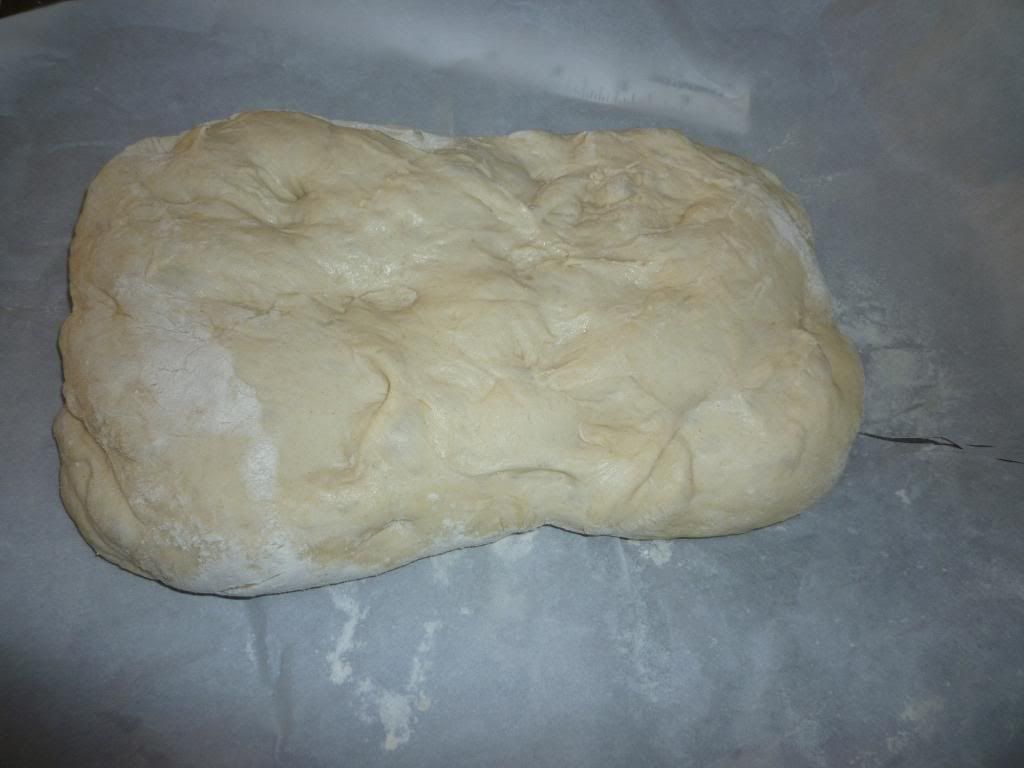
I just split the dough and turned it into two ciabatta rolls. It's possible that I over-degassed the dough because I had to maneuver the dough a lot and I had to cut it with a knife which was more difficult than I anticipated (I really need a pastry scraper). I'm hoping they turn out ok. Wish me luck!
Ciabatta rolls.
No Knead Pizza Dough: So this is probably a dough I should have given up on a long time ago. I guess I just have too much baker's optimism because so many of my slightly-botched creations turned out beautifully at my Alma Mater [2]. On the other hand, although the dough had not changed in size, it was bubbly on the top and a little on the sides (a sign of fairly healthy sourdough starter). So, I followed Rayner's instructions and took a cast-iron skillet (one that has been in the family for at least 3 generations!) coated it with olive oil and semolina flour and poured in the bubbly, goupy mass. Letting it rise for another two hours and them I'm going to bake it. We shall see!
Pizza Goup: Phase 2.
One of the things that is really helpful about Wild Bread is that it delves more deeply than my other bread books into the biology of yeast rather than the organic chemistry of bread which is the primary focus of most books [3]. Rayner says that "you must get to know the individual characteristics of your culture" (Rayner 33) which is why she leaves out instructions on proofing time other than the amount that the dough should have risen. I have never been a particularly good biologist or naturalist (I'm much more of a theory than a practice person). Servia and I are trying determine the activation time of our culture by noticing how long it takes between a feeding and the culture becoming a spongy mass with a layer of bubbles on top (peak of yeast leavening activity) and from there try to follow Rayner's instructions [4]. Maybe then we will have more luck with our pizza dough.
Endnotes
If you like cooking science, Whole Grain Breads: New Techniques, Extraordinary Flavor is a fabulous book. I learned all that I know about wheats, starches, crusts, and enzymes from this book and I highly recommend it as, at the very least, good reading to make yourself more knowledgeable.
I recently found out that the city of my Alma Mater is one of the best places for sourdough. It may have been the weather and the "yeasty beasties" (as Cerinthus calls them) in the region that helped more than my own personal luck or skill.
Obviously an understanding of the chemistry of bread is essential and as I mentioned before, Peter Reinhart's Whole Grain Breads: New Techniques, Extraordinary Flavor is fabulous in this regard. Understanding Baking is another wonderful text that even has a chart telling you the possible problems to diagnose your problematic loaves. Wild Bread has a similar appendix, but it is only focuses on sourdoughs (Rayner 152-155).
For the biology of sourdough and how to take care of it, see "Caring for a Sourdough Starter" (Rayner 32-40).
So in the spirit of trying to learn from my mistakes but not be definitionally insane (trying the same thing over and over and expecting a different result), I decided to make two very different new bread recipes today.
For dinner tonight: I am planning (with Servia) to make whole-wheat no-knead pizza crust from Wild Bread (Rayner 102-103). It looked easy and allowed me to try again with my sourdough culture because the bread is almost entirely made out of sourdough culture. Thus far I have mixed the ingredients together, covered the bowl to proof, and it has been proofing for over an hour with almost no change whatsoever in the "batter dough." One of the problems with Rayner's book is that few of the recipes include the amount of time to proof. Being fairly inexperienced especially in this climate, I have absolutely no idea how long it is supposed to proof, only that it should "double in bulk." This may make dinner difficult. However, she has a recipe for pizza sauce (Rayner 101) that looks great (so long as I remove the fennel seeds-- I really hate fennel).
My other experiment is on the opposite side of the spectrum in every way: it uses baker's yeast, white flour, and provides exact instructions. When I first started baking bread, one of the supposed fail-proof breads was Peter Reinhart's Pain à l'Ancienne Rustic Bread (Reinhart 52-54). I received the book (Artisan Breads Every Day) for my birthday, but I had not gotten around to it yet. It looks fairly easy. It involves a cold-fermentation method where the dough rises in the refrigerator overnight. I tried his stretch-and-fold technique rather than my usual slap-and-fold technique. Reinhart's stretch-and-fold involves a puring the dough onto a lightly oiled surface and stretching it and folding it: first the front-end, then the back end, and then from each side. After this, tuck the dough into a ball and let it sit for approximately ten minutes boefore repeating the process. This happens four times (all together) within 40 minutes (Reinhart 52-53). Interestingly, I just found a similar technique demonstrated on Bread Cetera. As this bread rises overnight, I have no idea what the bread will look like until tomorrow. The dough I made seems to be within the general range of the dough shown by Reinhart, but I did notice that it seemed slightly firmer than Reinhart's pictures, which makes me slightly apprehensive. I will post an update tomorrow.
Update: After over 7 hours, the pizza dough has hardly risen at all. It's bubbly like a sourdough culture should be but it just does not seem to have changed significantly. Anyway, we're thinking of leaving it overnight just to see if it will do anything and trying to bake it tomorrow. I am just fundamentally at a loss as to what the problem is with the starter. My only guess it that it's too liquidy: Rayner recommends a "sponge" starter which used 1:1 ratio of flour to water (that's by weight. She says 2:1 by volume). I guess I will have some more understanding tomorrow.
Can this really be pizza dough?
On the other hand, the ciabatta has risen wonderfully and as long as the air incorporation and gluten development were sufficient with the stretch-and-fold technique, it should come out quite well.
My bread has not been turning out well. I'm not sure whether it is the fact that I'm no longer in a climate conducive to bread or that I am no longer dependent on my bread in order to finish my thesis, but it has not been working. Even when the bread was working, I was never particularly good at making pizza dough. Tonight I cheated. I made pizza with my mom but we bought a pre-made whole-wheat dough from Trader Joe's. The pizza was great. I used my pizza stone which I've never used with pre-made dough and I was shocked at how well the dough cooked and cooked with the proper timing as the cheese, so right at the point where the cheese had melted sufficiently, the dough was soft and fluffy on the inside and clumsy on the outside. I also had fresh basil from the garden.
The other odd thing that has happened recently is new-found fame. I have been a member of sparkpeople.com for two years now. I have lost 50lbs and gone from being a size 14/16 to a size 2/3/4. My life has changed a lot. Recently, I wrote a blogpost about walking which was one of my primary weight loss tools. Chris Downie, the founder of sparkpeople.com commented on my piece and the next thing I knew, I had been catapulted into the spotlight because my blog-post was emailed out to everyone on the site. Suddenly, people were commenting on my page, emailing me for advice, and finding me all sorts of ways. It was really gratifying. The best part was that a number of people commented on how much they liked my writing. It reminded me that, although I am teaching part time right now, in my real life I want to be an academic and a researcher and will publish books that people will actually read (even if that readership is limited to the classical/philological community).
Speaking of sparkpeople, one of the books I've read this summer was Chris Downie's book. I thought that it was a quick read and extremely enjoyable. He began his site as a way to connect and inspire people. I felt that I was fulfilling that dream when so many people were inspired by what I had written about my walks around the neighborhood. It was fabulous.
Tonight I decided to make pizza. Amusingly, pizza is Cerinthus' food. His mother makes it a lot, but he has never been satisfied by the crust. Tonight he says "this is what pizza should taste like." WIN!
The pizza was not perfect, to be sure, but it was much closer than any homemade pizza he's ever tasted. Here is what I did. I took this recipe (which is technically a deep-dish recipe):
Pizza Dough (1): 1 1/2 cups warm water (about 110 degrees F) 1 (1/4-ounce) packages active dry yeast 1 teaspoon sugar 3 1/2 cups all-purpose flour 1/2 cup semolina flour 1/2 cup olive oil, plus 2 teaspoons to grease bowl 1 teaspoon salt
In a large bowl, combine the water, yeast, and sugar and stir to combine. Let sit until the mixture is foamy, about 5 minutes.
Add 1 1/2 cups of the flour, the semolina, 1/2 cup of the oil, and the salt, mixing by hand until it is all incorporated and the mixture is smooth. Continue adding the flour, 1/4 cup at a time, working the dough after each addition, until all the flour is incorporated but the dough is still slightly sticky.
Turn the dough out onto a lightly floured surface and knead until smooth but still slightly tacky, 3 to 5 minutes. I used the method of mixing recommended by Steve from Breadcetera (2).
Oil a large mixing bowl with the remaining 2 teaspoons oil. Place the dough in the bowl and turn to oil all sides. Cover the bowl with plastic wrap and set in a warm, draft-free place until nearly doubled in size, 1 to 1 1/2 hours. (I wish I had a picture. For me I kept the dough in a very warm area. It practically TRIPLED in size.)
Divide into 3 equal portions (I needed to make pizzas on a 12x12 pizza stone). From here, the original recipe requires deep dish pizza pans. I didn't have them, and I had just bought a pizza stone.
Note: this pizza stone is actually the unpolished part of a piece of granite that Cerinthus got for $4 at a tile store since I am a college student on a budget. I rubbed olive oil into it and the dusted it with semolina flour.
From there, I rolled out the dough, plumped up an inch or so for the crust, and then added tomato sauce (from Trader Joe's) and mozzarella. The dough was way too sticky (and the pizza peel I ordered has not arrived yet) so I used a flour-caked cookie sheet. It worked ok. When it was time to take the pizza out, it had solidified enough that I could move it freely, which was nice. I cranked the oven up to 500 degrees F and cooked the pizza until the cheese bubbled and there were patches of brown.
As is obvious, the first pizza got totally mangled as I put it into the oven. However, the crust rose admirably. The problem was that it didn't cook all the way through. I definitely need a solution to this. Ponticus, who came over to have some pizza, said perhaps heating the oven stone up to 500 degrees F and then bringing the oven temp down to around 400 to cook the pizza. I might try that next time.
While the pizza was rising, I decided to check on my yeast starter which, after 12 hours didn't seem to have much going on. But much to my surprise, as the pizza dough rose, so did the yeast in the starter. My starter still looks terrible on the top: but looks great from the side: If you can't tell from the picture, it's all bubbly, which means it's alive! I'm SO HAPPY. Sadly, tonight when I feed it I'm going to have to throw half of it out, per Breadcetera's instructions (3). I thought I had killed it because on of the tablespoons of flour I put in to start it was bleached flour (by accident). However, I found out that it grows anyway, although at a slower pace. I'm not sure if this is because of my apartment's heating, or because of the flour, but either way I'm totally happy it lived.


 with steel cut oats, flax seeds, and sunflower seeds.
 have been theonly two for which we did not attend the midnight showing (and I have not seen the final movie yet). We all have been really busy and

 (Reinhart 69-71). Fair warning: this takes a long time and I had to plan three days in advance. However, I have never had homemade pizza that tastes like this. Simply incredible. I highly recommend it for anyone wanting to make it. I made a few modifications (changing the starter base) and cutting the bread flour with whole wheat flour, but I am sure that the original version is just as good (or probably better) than mine. Here goes:


 , despite


 [1] and it had the same Frankenstein properties, and turned out over-proofed, yeasty, and with dense crumb despite it's original swelling. On the other hand, I did not know nearly as much about bread as I do now, so maybe I will get lucky and this bread will turn out fine.
 ). I'm hoping they turn out ok. Wish me luck!

 instructions and took a cast-iron skillet (one that has been in the family for at least 3 generations!) coated it with olive oil and semolina flour and poured in the bubbly, goupy mass. Letting it rise for another two hours and them I'm going to bake it. We shall see!

 is another wonderful text that even has a chart telling you the possible problems to diagnose your problematic loaves. Wild Bread has a similar appendix, but it is only focuses on sourdoughs (


