Thursday, September 23, 2010

Chicken Piccata Pasta

My mother and I cooked a lovely dinner tonight. Here is the recipe for the chicken piccata pasta, which is what we had (originally posted on "Cerinthus' Visit" and now posted, with slight edits)
Makes 2-3 servings.

Chicken
1 chicken breast, pounded
1/4 cup all-purpose flour
1 pinch of salt
1/2 teaspoon fresh ground white pepper
Pasta
2 1/3 cup of dried wheat fusilli
Sauce
1 tablespoon unsalted butter
2 tablespoons extra virgin olive oil
1 shallot, chopped
1/4 cup chicken stock
1/3 cup dry white wine
1/4 cup lemon juice (preferably fresh-squeezed juice from one large Meyer lemon)
30 (or so) capers
salt (to taste)
white pepper (to taste)
1-2 tablespoons Parmesan cheese (preferably freshly grated)
fresh chopped parsley, for garnish
Directions
  1. Place the chicken breast between wax paper or something of that type, and using the flat side of a meat tenderizer (or a heavy cooking spoon), pound the chicken to about 1/3-1/2 inch thick.
  2. Mix the flour, salt, and pepper on a plate. Drag the chicken through. Shake out any excess.
  3. Bring a pot full of water to a boil and add fuscilli.
  4. Heat 1 tablespoon of butter and 1 tablespoon of extra virgin olive oil in a large skillet. When butter starts to sizzle, brown the chicken breasts.
  5. When chicken has browned, remove from the pan. Add 2 tablespoon of olive oil to the skillet. 
  6. Add the shallots to the skillet and saute for about 1 minute or until beginning to brown.
  7. If you wish, cut the chicken into bite-size pieces or strips.
  8. Add the chicken stock, lemon juice, and the white wine (preferably dry) and allow it to simmer.
  9. After about 5 minutes or so, add the salt and white pepper to taste.
  10. After another minute, add the capers.
  11. Add pasta and chicken to the sauce. Add Parmesan and mix. Sprinkle parsley on top and serve.

Wednesday, September 22, 2010

But for Want of a Good Coffee Shop...

I love working in coffee shops. In my mind, they provide the perfect environment because:
  1. You're not disturbed, but you're also not alone (which can impede work because all you want to do is go and find people to avoid it).
  2. There is coffee which increases both comfort and productivity
  3. If you are hungry, there is usually food. The food costs money, so it dissuades you from eating to avoid your work, but you also know it's there if you need it so you cannot use the excuse about needing to go get food.
  4. The white noise of music or conversation is there for you, but you can easily drown it out with your own music.
  5. You look super cool sitting there with a scholarly book, math/science problem sets, classical poetry and a dictionary, etc
  6. There might be interesting people there to notice if you need a moment of a distraction before you get back to work, and you don't look like you're paying attention to them, because you're working
  7. Every good coffee shop has its own unique appeal.
I rarely went to the campus coffee shops when I was at school. The coffee was pretty great, but unfortunately I knew a lot of people who went there and worked there, which caused it to violate my first benefit of coffee shops (listed above). So instead, I used to walk about 0.8mi to my favorite coffee shop.

The shop had one long window that face the street so that the light came in and a person sitting in the chairs could see people walking by. For people-watchers like me, this was an ideal place. The coffee was generally of good quality and their multi-grain bagels were phenomenal. I used to just sit their for hours, working on my thesis or reading for one of my other classes.

The best thing about the coffee shop was the people. The baristas were lovely; they had nice senses of humor,  and they were young, friendly, and liberal. The population of the coffee shop was mostly made up of senior citizens-- most of whom had a strong christian background. The coffee shop was located in a predominantly christian neighborhood; there were seven churches in all within a three block radius of the shop. They had coffee every day. Because of the routine, they knew each other well and spent long hours drinking coffee and talking about their various childhoods as each were raised in different christian sects. There were even a christian quilting group that met there. There was also another group. There was a young web-designer, also a regular, with her dreadlocked-hair, her vulcan eyebrows, her homemade clothes, and her energetic seven-year old son. On the weekends, there were also a number of fathers with daughters and sons, often giving the children's mothers and hour or so of quiet time. And, of course, there were college students from my school and others the area. What was pleasantly surprising was the friendly ease with which the two groups interacted: the young liberal quasi-hippies and the old, christian conservatives. I do not think I have ever seen opposed groups at such peace and so pleasantly enjoying the company of one another.

I felt so at home there. I remember coming in with my laurels-- a display that I had fninished my thesis-- and one of the barristas asked what the occasion was. When I told them I had finished my thesis, the whole coffee shop applauded. It was so lovely. Then I enjoyed my coffee and bagel while reading for one of my last classes.

Unfortunately, since I moved, I do not have a new coffee shop in which I can translate. I really miss that atmosphere. There are three in the area that I have thus far discovered: one is too noisy, one is too sketchy, and one has these horrible aluminum tables that make a loud banging noise every time someone sitting at them moves. The search continues.

Tuesday, September 21, 2010

Political Thought

I do not generally write about politics (except perhaps Aristotle's Politics or the politics of education) but I thought today was a good moment to do so because of an article that I read this morning. For my little political moment for today I thought I would stand firmly behind the primary political belief of my mom's family: people should vote.

People on my mom's side of the family, or really on any side of my family, disagree on political matters. However, they always thought people should vote. My great-grandmother, against the strong wishes and recommendations of her husband, campaigned for women's suffrage. There is a beautiful set of letters between the two of them that demonstrate their feelings on the subject.

I was thus distressed by an article in the New York Times that said that women are less likely to vote in this election. It seems to me that women, who fought so hard less than a century ago to secure the vote in the first place should utilize this power. Even if the outcome does not go the way one might have hoped, participation in the political process is a necessary step for holding representatives accountable for their actions, both for rewarding those who fight for the right things and for attempting to curb the effects of those who might create problems.

Sunday, September 19, 2010

Grad School: The Reading List

One of the things that most classics grad programs (e.g. Berkeley, U of Toronto) seem to require from their applicants is a reading list of texts read in the original language. Presumably this is because classes are not standardized at different schools, and this replaces what might once have been a list of classes. I have read quite a few texts in their original language-- especially Greek texts. Some of these texts, given when I read them, I read or remember better than others. However, Berkeley's list was a little different. It gave examples of what it considered to be second and third year classes, and expected two more semesters on top of that. This was fine in principle, but the texts they provided as examples were kind of scary.
  • Homer (3-4 books)  I haven't read Homer since highschool, and I only read Book I of the Iliad.
  • Plato (1 short dialogue) I read the Phaedrus which is much harder than most of the short dialogues (although I have to admit, I had a lot of trouble with it) plus selections of a number of other Plato's texts.
  • A complete Greek Drama I read the Bacchae back my freshman year, which was awesome, but a long time ago and I think it would be a lot easier to go back over it now. I also read about 90% of the Agamemnon.
  • Aeneid (3-4 books) I read Book 8, and excerps from books 10 and 12 in my second year Latin class, but still, obviously not enough.
  • Republican Prose (40-50 pages) Pro Caelio and selections from Caesar's Civil Wars, which I would think add up to about 40 or so pages.
  • Horace (30 poems) none until yesterday-- and I read I.1, 5, 9.
My lovely friend Propertius II and I went over my readings of I.1 and 5 today, during which I think I enjoyed the poetry much better than the first time that I read it. It is so nice to have another classicist who is willing to patiently work and discuss with me (as well as provide, at least in theory, some mutual benefit because he has not read much Horace either).

However much I am enjoying my grad school prep, at least at the moment, I am already behind. The timeline that Princeton Review puts out really scared me. I am so behind.

At an alumni dinner tonight I met a lovely classics grad who is getting his PhD working on Homer. I only hope that I can get into grad school and move things forward in the direction that he did. I hope also that I can live up to my own expectations bot in getting into and doing well in graduate school.

Saturday, September 18, 2010

Teaching through the Invisible Wall

I proctored another practice test today. Practice tests are a long four hours and I finished Genres in Dialogue: Plato and the Construct of Philosophy and was able to cross it off of my reading list [1]. I also read two other works which I will discuss in detail over the next few days.

At one of the five-minute breaks in the four-hour exam, I asked my students how their college applications were going. People were nervous-- and rightfully so-- but were in the process. I told them that I was doing graduate school applications, and they were a nightmare because they do not have a common application and require a lot of strange GPA manipulations (depending upon whether the school is focused on your grades in courses in your major, in your last two years, etc). After explaining this, I realized that this attempt to explain my sympathies with the students' situation was precisely the wrong approach. They do not want to hear how hard my experience is-- or the things that may be awaiting them after college-- but rather they would like some encouraging words.

I always thought, while I was in high school, that when I became a teacher (I wanted to be a professor of course, but I figured that it was a similar principle) that I would understand the plight of the student and not be alienated from it in the way that my teachers seemed to be. My specific specific qualms were with busy-work, "creative projects" as graded material, and improper balancing of review and new material (in either direction). Now, I realize that there is as much of an invisible wall between my students and me as there was between me and my teachers. Maybe it is the inevitable position of being a teacher.

One thing that cheered me up was an essay that a student wrote today. The topic asked the students to consider what type of learning should be done in schools. One of the girls related a personal anecdote about a friend of hers sitting at lunch one day and complaining that school did not have enough breaks and did not incorporate enough creative learning. The girl questioned her friend, and through questioning the friend agreed that although it might feel that way, but the purpose of school was to provide a learning experience and that it was ultimately useful. I do not know if the anecdote was true, but it made me feel a little bit better.

Endnotes
  1. Genres in Dialogue: Plato and the Construct of Philosophy is fabulous. Andrea Nightingale utilizes a mixture of history and classical scholarship with Bahktin and a smattering of literary theory to provide an energetically written and scholastically footnoted work that provides a fascinating analysis of Plato and the development of philosophy as a genre. I will do a full review soon.
Genres in Dialogue: Plato and the Construct of Philosophy 

Friday, September 17, 2010

Cerinthus Reports: Where is Electra?

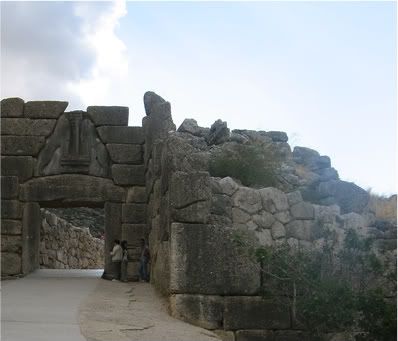
Sulpicia Asks: Where was Electra lamenting in Sophocles' Electra?
I recently saw a wonderful production of Sophocles' Electra. You can read the review on my blogpost. In the play, Electra spends most of her time crouching outside of the gates of Mycenae.

Cerinthus Answers: Right where those tourists are in my photo!
Photobucket
Photo by Cerinthus

Wednesday, September 15, 2010

Updates: Kindle and Free Books

I wrote two blogposts of the last few weeks which I feel are in need of updating: A Bibliophile's Review of the Kindle DX and Problems With Free Books. (I also recently updated the Blog on the Minoan Octopus Jar.)

Kindle for Cooks
One of the things that I did not mention in my original review is my use of the kindle for cooking. I use it in two ways. One is to download and put recipes on my kindle and stand it up on my counter-top. This only works, obviously if one downloads a cookbook or creates a PDF or MOBI document. I used a particular case, a platform kindle case, that allowed me to stand the kindle upright so that I could read the recipes easily. The other way that I used the kindle was to have it read to me while I was cooking. I downloaded a free version of The History of the Peloponnesian War and had the Kindle read to me while I was cooking so that I did not waste time [1]. It was pretty helpful, except for the pronunciation of the Greek names. For example, Themistocles (the-mist-oo-cleez) was pronounced (the-mis-do-cls). Although the humanoid voices can be kind of annoying, it gets the information across and entertainment can be found by poking fun at it.

Kindle DX Wireless Reading Device, Free 3G, 9.7" Display, Graphite, 3G Works Globally – Latest Generation

As a random technological sidenote, I have had my phone for 6 years and it is finally beginning to break down (people cannot hear me when I answer the phone and I have to shout, etc). Does anyone have a good recommendation?

A Clarification and More Amazing Free Books
I realized that I never explained the meaning of the title "The Problems of Free Books." The idea is that Google Books provides some downloadable free books as well as providing essentially an enormous, no-membership-required digital library that allows the reader to browse through editions of books online for the purposes of research, as well as for the ability to preview books online. For any other book, there is the difficulty of finding the book in the first place, making sure that it is the correct edition, etc. Speaking of free ebooks, there is another Amazing Site (referred to me by Propertius II) that has a bunch of academic books marked "public" which can be read online.


Endnotes
  1. At the time when I was doing this, I was taking a class on Thucydides: Book 1 in Greek, I was attempting to read the rest of Thucydies' History of the Peloponnesian War for context. Usually I would read the beautiful Landmark Edition, which was a wonderful gift from my parents, but I ended up just trying to breeze through the kindle edition, and look at the Landmark for reference.

Movie Review: Cairo Time

Juliette: "I have always wanted to go to Alexandria"
Tareg: "The library burnt down, you know. You would be surprised how many people ask me that."

Cairo Time is the brilliant and unexpected romance of an American woman, who is the wife of a UN worker in Egypt, and an Egyptian man who is a former colleague of her husband. While Juliette's husband is trapped in Gaza trying to help solve a refugee camp crisis, Juliette, a woman with an adventurous spirit, cannot stay cooped-up in her hotel in Cairo and sets out to explore the city. Finding a number of unforeseen complications with wandering alone, Juliette befriends two unlikely people: the girlfriend of another UN worker who has been in Cairo for two years, and Tareg, a close friend and retired colleague of her husband who was sent to pick her up at the airport. As he accompanies her on her explorations in Cairo, Tareg exudes a quiet vibrancy, charm, humor, and earnestness which are as captivating as the city itself.


I found this movie incredibly charming. It was beautifully shot, brilliantly acted, and well written. I found the story to be believable and powerful, without being overwrought or tied up too perfectly. I recommend it highly. The soundtrack is also incredible.