Tuesday, September 28, 2010

Pew Forum Study on Religious Knowledge

There seems to be a lot of news going around recently about the Pew Forum's Study on Religious Knowledge. The Pew Forum put together a 15 question quiz, which you can take by clicking here, on basic religious knowledge. The original survey was done by phone to a set of randomly selected adults and contained 32 questions. This New York Times article discusses the results.

I wanted to look at the full results of the study but my browser keeps telling me that it cannot access it. Maybe the site is down from too many hits.

Although my primary study of religion has been studying Ancient Greek and Ancient Roman religions (and even in these two disciplines I am far from knowledgeable), I managed a 13/15 on the quiz (87% correct, and in the 97th percentile of participants). I missed one out of lack of knowledge, and one because I second-guessed my original answer. The breakdown of scores by gender, religious affiliation, race, church/temple/mosque attendance, and education is fairly fascinating.

I have written a little bit on Greek Religion, and especially it's use in the work of specific tragedians, on Platonic Psychology. My main source of knowledge on Greek Religion comes from my early education in the fifth and ninth grades on Greek mythology, my own reading and supposition, and almost every one of my classics courses in college. I would also recommend Walter Burkert's Greek Religion, which was a fabulous resource, although it is less detailed than I would like.
Greek Religion: Archaic and Classical (Ancient World)
One of the things I am still looking for is a detailed explanation of Greek bird omens and their interpretation. If anyone has a good source, post a comment or send me an email (sulpicia3 [at] hotmail [dot] com).

Monday, September 27, 2010

Polytonic Unicode Greek for Windows and a Question for Computer Geeks

I posted this on Platonic Psychology, but I wanted to try to reach the widest audience of people to find out if anyone could help me with this computer issue.

One of the things that I have been aiming at for quite a while now is being able to easily write polytonic Greek with relative ease on the computer. I have difficulty with Macs so the computers to which I have access are a Windows XP machine and a Windows 7 machine. I finally found two sites that have helped me out: this one which allowed me to download the Unicode Greek Keyboard for Microsoft and this one which helped me change my settings so I could toggle between the two [1] .

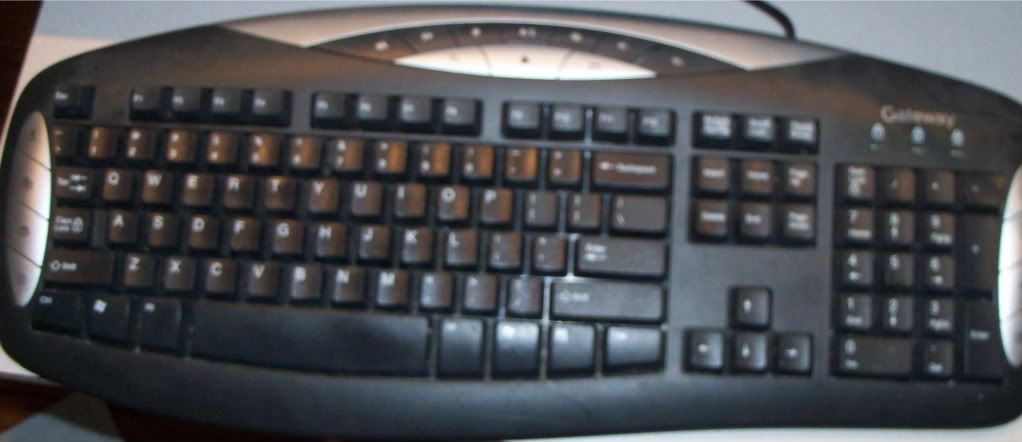
I can now toggle beautifully: αβγδεζηθικμνξοπρστυφχψω. However, I can only get one of the accents to work ά. According to the website, I need a dead key to make this work (i.e. a key that will postpone the action on the keyboard so it can be modified by a further keystroke). I am supplying a picture of my keyboard. Does anyone know what my dead key should be or have any ideas? Comment or email me at sulpicia3@hotmail.com. Thanks!

keyboard
Sorry for it being blurry. The silver keys are just quick-function buttons such as calculator.


Endnotes
  1. An easier way to do this than the website recommends (for XP and AFTER you have downloaded the Unicode Greek Keyboard) is to go to Control Panel. Double click on Regional and Language Options. Click on the Languages Tab. Click on the Details button. Click on the Key Settings button. Click on the Switch between input languages line of text. Click on the Change Key Sequence button and then select one of the two key sequences. Click on the Ok buttons all the way through to save your changes.

It was terrifying enough applying to grad school before Professor Michael Pakaluk put his nose in it...

Word of warning: this post begins with a lengthy personal anecdote, you can skip to the * if you want to get to the point more quickly.
Plato Complete Works
I took my first ancient philosophy class in July 2009. I was expecting to hate it, given what I deemed was the gross analytical bent in academic philosophy in the United States characterized by an examination of the logic and structure of linguistic utterance to the point of nonsens. As it turns out, although I may have been correct about philosophy at large (I have no way of knowing), I was surely wrong about this class.

The class was, in fact, analytic in its approach. However, the questions asked were lively and fascinating. We read Plato's Meno and Theatetus (with a recommendation to read Burnyeat's introduction) in small pieces and had a 2h30 discussion format in which to discuss in-depth questions on each reading. It was magnificent. And the PhD candidate running the class was incredible (and was an alumnus from my college!)

The questions, designed by the Grad student running the seminar, asked us to explore the logic behind each set of claims and exchanges as well as the reason for each story, tangent, or explanation made by one of the characters. Instead of looking at the rhretorical, historical, grammatical, and cultural meanings of the passages, the close analysis was on the logical through lines of the narrative in each particular speech or interchange. Although most of the class had a background in philosophy (many were on the cusp of graduating in philosophy) all of them seemed genuinely interested in the classical contexts of specific statements if it provided a means by which to understand the logic or the rhetorical weight of a statement (the lack of context and focus solely on language was something that had given me a distaste for analytic philosophy in my few encounters with  it). When I finished the class, I knew I wanted to go into Ancient Philosophy. The dissection at such a minute level was far more illuminating than I expected. However, I wanted to approach it from a more classical bent-- mixing what I thought was admirable about the approach to that wonderful class used in conjunction with what I found incredible about a work like Thomas Szlezak's Reading Plato [1].

Going into my senior year and without proper prerequisites, I could not suddenly jump into a philosophy-heavy program. Even so, I was not dissuaded. I still would like to work on classical philosophy in graduate school, although, perhaps move into it through a classics department.

*One of the things that the PhD candidate who lead my class showed me was Philosophical Gourmet Report: Ancient Philosophy. Although he had a great interest in the subject, ancient philosophy was not his primary field. He warned me, of course, not to take the list at face value, and helped me check through faculty lists (to survey names and specialties of the professors at each institution. Using a combination of hearsay, investigation into the faculty of a number of schools, the Classical Journal's List of PhD programs in Classical Studies (to which Propertius II directed me), Philosophical Gourmet Report: Ancient Philosophy and I have made a preliminary list. Then, in my internet wanderings I discovered this article, evaluated the Philosophical Gourmet Report: Ancient Philosophy.

The article on a blog called Certain Doubts describes a posting by Professor Michael Pakaluk on his blog Dissoi Blogoi acerbically criticizing Philosophical Gourmet Report: Ancient Philosophy (points 3-6) and excoriating any of those who choose to employ it (points 1-2). Probably much more so than the author of Certain Doubts, I do not have the guidance that Pakaluk or another professional in the field might provide. Ancient philosophy-- which consisted of one professor at my alma mater-- was decisively separated from any connection with classics whatsoever and I was, instead, discouraged from "serving two masters" by leaping into a hybrid field. Although I think criticisms 3-6 on Dissoi Blogoi were valid, the first two points which begin with the phrase "any student" are absolutely a personal attack on those students who choose to view these rankings for the sake of gaining information, even though Pakaluk's response claims that they are not. I may know the scholars I would like to work with and those I would dislike, but I have no idea whether a PhD from one institution or another is more likely to land me a better job-- or whether the recommendation of one faculty member over another is likely to do the same.

And so, the search for a graduate program continues...

Endnotes
  1. If you do not like Plato for some reason or are suspicious of Plato or are tired of the old, traditional interpretations of Plato, I cannot recommend Reading Plato more highly. It is 120 pages of pure awesome. Szlezak provides incredible insight and context to a complex philosopher and revolutionized my own thought about Plato. It was originally published in German, Szlezak's native tongue, as Platon lesen. This is of course reason #87 that I need to learn German.

Sunday, September 26, 2010

My Favorite Summer Dinner

When I was little, I was a very picky eater. The only dish I could rely on at restaurants was pasta with olive oil and garlic. That was one of the very small number of things that I ate for years.

Now, my palate has expanded significantly. My oil and garlic pasta has become whole-wheat fusilli instead of my traditional angel hair. Instead of asking for "no green stuff" I pile it on adding fresh basil from the garden and broccoli (and depending upon my food-supplies and my mood, green onions or frozen spinach). However, to this day it still remains one of my favorite dishes.

This dish can be made with any variety of vegetable substitutions and pretty much any type of pasta. Bell and sweet peppers are always a nice addition, if you have them around. Also, chicken is a lovely addition to this dish. I had it with chicken just last night.  Experiment!

Oil and Garlic Pasta Stir-Fry 2 servings
Pasta
Prepare 2 servings of pasta. I suggest a rigatoni, fuscilli, or an linguini, but it's your choice.


Stir-Fry
2 tablespoons Extra Virgin Olive Oil
5 or so garlic sections, either finely chopped or pressed into the pan
1/4-1/3 cup fresh basil
1/4 cup sun-dried tomatoes sliced into thin slices
1 cup broccoli, chopped
Parmesan cheese, to taste

Directions
  1. If pasta will take about 10 minutes to cook (as it does with dry fuscilli), start pasta first.
  2. Heat a large skillet over medium heat with olive oil and garlic.
  3. Once the garlic has been sizzling for 45 seconds or so, but is not yet golden, add sun dried tomatoes. Move everything around in the pan for 1-2 minutes.
  4. Add basil. Stir for about 1-2 minutes.
  5. Blanch broccoli so it is a little bit al-dante (in the microwave or by whatever means necessary). Then add the broccoli to the pan. Stir and let finish cooking for 1-2 minutes.
  6. Then add the pasta. Add a little more olive oil if needed.
  7. Sprinkle Parmesan over the top. Stir for 30 seconds. Serve.

Saturday, September 25, 2010

Raw Foodism and Evolution


I stumbled upon this NPR piece a little while ago and, being both a cooking and evolutionary biology enthusiast, found it fascinating. Apparently cooking helped make humans smarter (by allowing for larger, more complex brains) because cooked food can be digested more easily and allows a faster extraction of nutrients from the food source.


The piece, which is very well done except for some annoying chewing noises at the beginning, starts at about 5:45 after a short note on companies hiring marine scientists to keep their mouths shut about the oil spill.

When I stumbled across the piece, I immediately sent it to Cynthia, who had tried raw-foodism for a while. She noted that, like the piece described, she felt clean and healthy at first, but began to notice decreasing energy. This is apparently because the human body likes the roughage from a raw food diet, but it requires so much energy to process the calories that ultimately one stops getting enough nutrients and vitamins.

Thursday, September 23, 2010

Chicken Piccata Pasta

My mother and I cooked a lovely dinner tonight. Here is the recipe for the chicken piccata pasta, which is what we had (originally posted on "Cerinthus' Visit" and now posted, with slight edits)
Makes 2-3 servings.

Chicken
1 chicken breast, pounded
1/4 cup all-purpose flour
1 pinch of salt
1/2 teaspoon fresh ground white pepper
Pasta
2 1/3 cup of dried wheat fusilli
Sauce
1 tablespoon unsalted butter
2 tablespoons extra virgin olive oil
1 shallot, chopped
1/4 cup chicken stock
1/3 cup dry white wine
1/4 cup lemon juice (preferably fresh-squeezed juice from one large Meyer lemon)
30 (or so) capers
salt (to taste)
white pepper (to taste)
1-2 tablespoons Parmesan cheese (preferably freshly grated)
fresh chopped parsley, for garnish
Directions
  1. Place the chicken breast between wax paper or something of that type, and using the flat side of a meat tenderizer (or a heavy cooking spoon), pound the chicken to about 1/3-1/2 inch thick.
  2. Mix the flour, salt, and pepper on a plate. Drag the chicken through. Shake out any excess.
  3. Bring a pot full of water to a boil and add fuscilli.
  4. Heat 1 tablespoon of butter and 1 tablespoon of extra virgin olive oil in a large skillet. When butter starts to sizzle, brown the chicken breasts.
  5. When chicken has browned, remove from the pan. Add 2 tablespoon of olive oil to the skillet. 
  6. Add the shallots to the skillet and saute for about 1 minute or until beginning to brown.
  7. If you wish, cut the chicken into bite-size pieces or strips.
  8. Add the chicken stock, lemon juice, and the white wine (preferably dry) and allow it to simmer.
  9. After about 5 minutes or so, add the salt and white pepper to taste.
  10. After another minute, add the capers.
  11. Add pasta and chicken to the sauce. Add Parmesan and mix. Sprinkle parsley on top and serve.

Wednesday, September 22, 2010

But for Want of a Good Coffee Shop...

I love working in coffee shops. In my mind, they provide the perfect environment because:
  1. You're not disturbed, but you're also not alone (which can impede work because all you want to do is go and find people to avoid it).
  2. There is coffee which increases both comfort and productivity
  3. If you are hungry, there is usually food. The food costs money, so it dissuades you from eating to avoid your work, but you also know it's there if you need it so you cannot use the excuse about needing to go get food.
  4. The white noise of music or conversation is there for you, but you can easily drown it out with your own music.
  5. You look super cool sitting there with a scholarly book, math/science problem sets, classical poetry and a dictionary, etc
  6. There might be interesting people there to notice if you need a moment of a distraction before you get back to work, and you don't look like you're paying attention to them, because you're working
  7. Every good coffee shop has its own unique appeal.
I rarely went to the campus coffee shops when I was at school. The coffee was pretty great, but unfortunately I knew a lot of people who went there and worked there, which caused it to violate my first benefit of coffee shops (listed above). So instead, I used to walk about 0.8mi to my favorite coffee shop.

The shop had one long window that face the street so that the light came in and a person sitting in the chairs could see people walking by. For people-watchers like me, this was an ideal place. The coffee was generally of good quality and their multi-grain bagels were phenomenal. I used to just sit their for hours, working on my thesis or reading for one of my other classes.

The best thing about the coffee shop was the people. The baristas were lovely; they had nice senses of humor,  and they were young, friendly, and liberal. The population of the coffee shop was mostly made up of senior citizens-- most of whom had a strong christian background. The coffee shop was located in a predominantly christian neighborhood; there were seven churches in all within a three block radius of the shop. They had coffee every day. Because of the routine, they knew each other well and spent long hours drinking coffee and talking about their various childhoods as each were raised in different christian sects. There were even a christian quilting group that met there. There was also another group. There was a young web-designer, also a regular, with her dreadlocked-hair, her vulcan eyebrows, her homemade clothes, and her energetic seven-year old son. On the weekends, there were also a number of fathers with daughters and sons, often giving the children's mothers and hour or so of quiet time. And, of course, there were college students from my school and others the area. What was pleasantly surprising was the friendly ease with which the two groups interacted: the young liberal quasi-hippies and the old, christian conservatives. I do not think I have ever seen opposed groups at such peace and so pleasantly enjoying the company of one another.

I felt so at home there. I remember coming in with my laurels-- a display that I had fninished my thesis-- and one of the barristas asked what the occasion was. When I told them I had finished my thesis, the whole coffee shop applauded. It was so lovely. Then I enjoyed my coffee and bagel while reading for one of my last classes.

Unfortunately, since I moved, I do not have a new coffee shop in which I can translate. I really miss that atmosphere. There are three in the area that I have thus far discovered: one is too noisy, one is too sketchy, and one has these horrible aluminum tables that make a loud banging noise every time someone sitting at them moves. The search continues.

Tuesday, September 21, 2010

Political Thought

I do not generally write about politics (except perhaps Aristotle's Politics or the politics of education) but I thought today was a good moment to do so because of an article that I read this morning. For my little political moment for today I thought I would stand firmly behind the primary political belief of my mom's family: people should vote.

People on my mom's side of the family, or really on any side of my family, disagree on political matters. However, they always thought people should vote. My great-grandmother, against the strong wishes and recommendations of her husband, campaigned for women's suffrage. There is a beautiful set of letters between the two of them that demonstrate their feelings on the subject.

I was thus distressed by an article in the New York Times that said that women are less likely to vote in this election. It seems to me that women, who fought so hard less than a century ago to secure the vote in the first place should utilize this power. Even if the outcome does not go the way one might have hoped, participation in the political process is a necessary step for holding representatives accountable for their actions, both for rewarding those who fight for the right things and for attempting to curb the effects of those who might create problems.