Thursday, September 9, 2010

Unconventional Education #2

Two of the reasons that I was so interested in Sugata Mitra's [1] TED Talk in my last blogpost are that I am now working as an educator and that I am a product of progressive education (in my formative elementary school years). From this, I understand the power of working in groups and students teaching themselves and each other.

I went to a progressive elementary school that was built on John Dewey's conception of experimental learning. We spent most of our time in school working in groups, block building, and wood working. We went on field trips to the source of each of the sites that we were studying. I remember vividly sitting through mass at a modern monastery when studying the life of medieval monks and getting up at 3am to go to one of the groups of vendors that supplies restaurants in order to see how the city worked. I gained a curiosity and a passion for learning there.


I picked the college that I did partially on the idea that it would be a return to these unconventional roots. Although it had grades, classes, and majors, like any traditional institution, there was a high premium put on working in groups for certain classes as well as an encouragement for self-competition rather than interpersonal competition. This was a lovely change from my traditional high school, and it fostered precisely the intellectual environment that I craved. In my senior year, I started a Heidegger seminar which met on Friday nights to discuss Being and Time. This class utilized a combination of technology (sometimes listening to Hubert Dryfus' lectures from his Philosophy 185 class, as well as individual in the group finding things online), and group work (the discussions every week) allowed us to gain an incredible amount of information out of the text. Emergence, in Mitra's words. We had very little outside intervention, except for a few visits from a wonderful German professor. I unfortunately was not able to read and participate in this as much as possible due to writing my thesis, but the Heidegger group was productive and wonderful and it was one of the great parts of my education.

The SAT prep that I teach involves some amount of group work in each class. Although often times the group work devolves into talking. The students in my class are tense about school, sports, and college applications, and many of them go to school together. However, the other day I witnessed a great moment. Two of the girls in my class, who have the most trouble with math were working together. One of the smartest, but also one of the tougher girls in my class, ended up in a group with them. When I came over to check on the group, she was helping them-- really explaining carefully how each of the math problems worked and encouraging them. I did not even have to help them out and I was able to focus on some of the other groups that were having trouble focusing. It underlined, for me, the true value of working together.

In some ways, that this self-generated learning is what I am trying to do this year. I am attempting to channel my curiosity in a way to further my own education and solidify those things I learned in the past in my mind. I am not, unfortunately, in a group of any kind (although there is an advanced calculus class at a local school I would absolutely love to take), but I am using the internet, the books I have around, and material from my old courses in order to try to create my own education. Part of the reason I write Platonic Psychology is that I provide a collection of resources for anyone who is out there looking, but more to provide me with a hypothetical group with whom I can interact. By articulating my thoughts to these theoretical people, I solidify my thoughts and allow them to grow (and hopefully generate emergence). So hopefully it will all work out.

Endnotes
  1. I just discovered his blog and found it to be thoroughly charming.

Wednesday, September 8, 2010

Unconventional Education

My mother just sent me an incredible video. I'm not, generally speaking, one of those people who watches a lot of videos online, but this was so stunning that I had to share it. This video is from a TED conference, in which Sugata Mitra discusses the use of computers in child-driven education. The initial premise that he poses is that the places in the world to which good teachers cannot or will not go are not only the places that need them the most, but also the places that become the hotbeds of problems in the world. From there, he started an experiment by placing computers in slums in order to see if children could learn from them without instruction.


Mitra poses this hypothesis at the end of the talk, which he intends upon proving experimentally in the next five years:
"Education is a self-organizing system [1] where learning is an emergent phenomenon [2]."
This video is fantastic and I highly recommend it.

Endnotes
  1. Mitra defines a self-organizing system as "one where the system structure appears without explicit intervention from outside the system."
  2. Mitra defines emergence as "the appearance of a property not previously observed as a functional characteristic of the system."

Tuesday, September 7, 2010

Wine Snob: The First Installment

Wine snob is kind of a joke. I am not educated in wines. In fact, my alcohol tolerance is so low that after about two glasses of wine not only can I feel the alcohol but the wine starts to taste funny (even if it is great wine). However, I like wines and I have some extremely limited knowledge of California wines. So I thought that I would add a wine entry, now and then, to my blog in order discuss and review wines. I find this review to be especially relevant because wine not only compliments cooking, but also may be used in the cooking itself.

My first wine to review is a 2002 Taft Street Savignon Blanc (Poplar Vinyard) from the Russian River area of Sonoma County, California. As a note, I'm not much of a white wine person, so my knowledge is even more limited. The wine was a gift, but I think it has been sitting a little too long. It has turned to a deep, rich golden color, which I think is pretty problematic for white wine, especially a Savignon Blanc. The taste is light and fresh, but the aftertaste has the distinctive bite of a middle shelf vodka, which I think means that it has become more alcoholic while sitting in the bottle for the last eight years.

However, the light fresh taste of the wine means that it will probably be good for cooking, and most of the alcohol will burn off. I plan on making my favorite butternut squash ravioli in a sage cream sauce later this week (yum!) and I will post my new and improved recipe, as well as a review when I do make it.

Does anyone have any idea on how to tell how long one is supposed to age wines? Is there some science, or does one just have to email a vintner?

Monday, September 6, 2010

A Bibliophile's Review of the Kindle DX

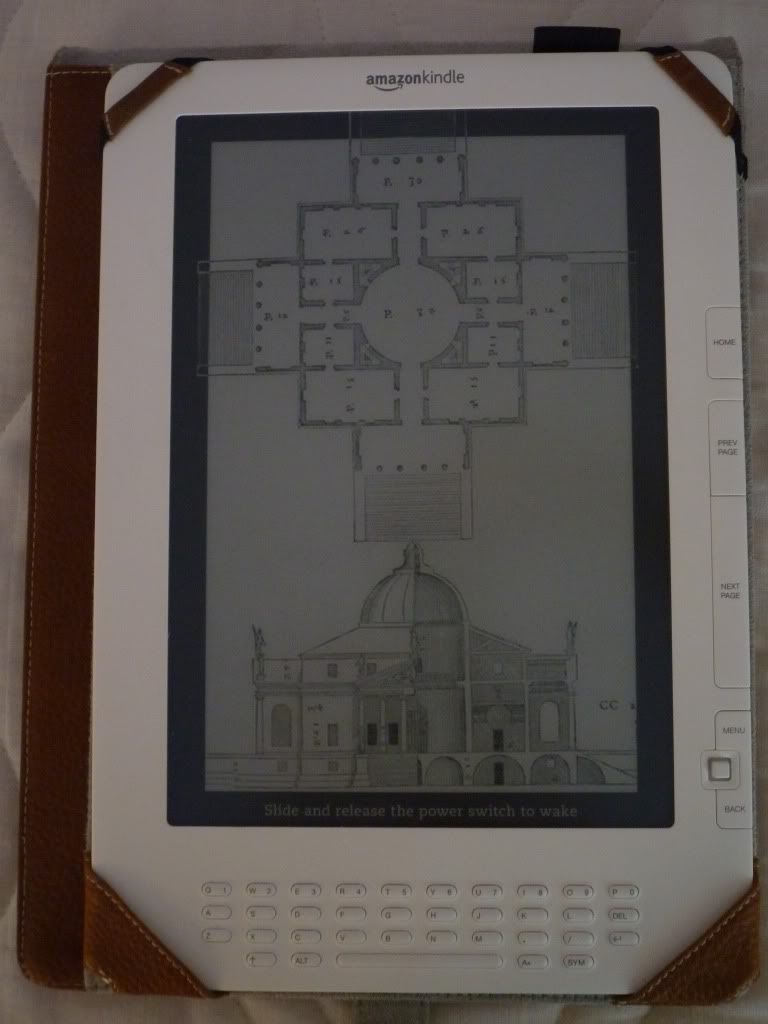
I have had my wonderful Kindle DX for a year now. It was a wonderful and incredibly useful gift from a close family friend. I think that is ample time to explore the benefits of the Kindle and also to demonstrate that owning an eReader is not going over to the dark side.
My Kindle DX
As I have mentioned before, I have a visual processing disorder, so reading off of anything (and especially a computer screen) for any length of time is difficult. Unfortunately, like at any university, many of my classes required supplementary readings that were held by online reserves, and had to be read either on a computer screen or by printing them out. Although I read many of them on paper, printing at school, as well as my own printing (with the cost of ink/toner) was expensive. Both of the two doctors who I consulted recommended the Kindle DX to me, because of the e-ink screen and because font size and word spacing are easily changeable, as well as the reading aloud function.

I was very skeptical, at first, of the idea of an electronic reader. I am a serious bibliophile (as presumably anyone can guess from the bookshelf at the top of my blog and my reading list). I love the feel of books in my hands, the tactile sensation of turning the pages and hearing the distinctive sounds of the paper. I love new books, so shiny and perfect one hardly wants to open them. I ordered a copy of Immanuel Kant's Groundwork for the Metaphysics of Morals that releases the distinctive smell of jasmine soap upon opening. I also love used books, a little worn or with an inscription by the previous owner. For one birthday, my parents bought me a copy of Idle Thoughts of an Idle Fellow from the mid 1890s, with a beautiful sky-blue leather cover and accents of gold leaf, a little worn on the spine with use.

However, when I received my Kindle DX, I was almost immediately won over. The device itself is sleek and lightweight (and the new graphite ones are actually even sleeker). I can carry 3,500 books and documents. While I was at school, I no longer had to print, I could do my electronic reserve reading right on my Kindle [1]. Furthermore, I could download any PDF from Jstor or any of the wonderful electronic journal archives for research or pleasure reading and read them or save them for a later date. There are also a ton of free books on Amazon and Project Gutenberg (mobi documents) for the kindle, which can be annotated the same way that a traditional kindle document can.

I also found that writing my thesis, the Kindle was a real lifesaver. One of the primary texts that I used was Plato's Laws. I read the Laws in English, and then read selected sections I needed in the Greek. Much of the time I needed to refer to specific passages that all used the same word or phrase and sometimes either calculate the frequency of those phrases or discuss their placement in the text. Although I used the Thesaurus Linguae Graecae for much of the searching, I also used the kindle search function in the English version in order to expedite certain processes as well as to contain vast annotations on particular passages.

I do have a number of criticisms of the kindle, some of which Amazon has addressed and fixed.
Concerns that Amazon has recently fixed:
  1. No Organization-- The newest software update that I downloaded allows for collections of books, which means that I can organize the books in any way I choose. This is a huge help given how many ebooks I have.
  2. No Zoom-- The newest software update also includes a zoom for PDF documents, which is very helpful.
Concerns Amazon still need to fix:
  1. No way to refer to page numbers from the print edition. I was lucky with Plato, because Plato scholars refer to Stephanus pagination, rather than page numbers from any particular edition. However, this can be a serious issue when writing academic papers. It usually means that one has to check a print edition of the library as well and then cross-reference, which is really lame. It also provides a difficulty in citing pages for class discussion, which is part of why the kindle experimentation program at universities was not a raging success (my school included).
  2. No way to borrow books. This is truly unfortunate. I lend print copies of my books to my friends all the time, and my mother and I frequently both read a book. I don't want to have to lend someone my kindle, because that is lending a portion of my library and it keeps all of my notes. 
  3. The TERRIBLE pronunciation of times and sometimes problematic inflection of the reader. I know, it's difficult to get a computer to pronounce things properly. When I was taking a Thucydides course where we were focusing intently on Book I (in Greek), I would listen to the rest of the book (in English) while I was cooking or cleaning to provide context. I often had to go over and check the text because I could not understand the names and place names to which she was referring (I usually listened to the female voice).
  4. Problematic edition differences. According to an Amazon representative that I talked to once, publishing companies put out their own version of the kindle books rather than Amazon doing it themselves. I understand this principle. However, I cannot understand the lack of standards between different publishers. One of my favorite features of the kindle is linked footnotes, and a lot of books just have endnotes in the back instead of the linked footnotes. It seems like it would be easy to have across-the-board standards for the different companies.

    Overall, the kindle is awesome. I now only have to lug one book and a kindle on a trip, instead of taking 3-4 books with me. I love my kindle so much that I bought a second one off a friend (who got it as a gift and was not a fan) and gave it to my mom, who also loves it.

    If anyone is interested, the case I have is also awesome.

    Update 02/14/11: There are new updates for the kindle. The first two problems (page numbers from the print editions and borrowing books) have now been fixed, although the former has only been solved on certain kindle books and only for the newest editions of the Kindle 6". I discuss this in a recent blogpost. The borrowing books feature is also questionable. The book leaves your kindle and moves to the other person's kindle for either 2 or 3 weeks, and then it returns. Each book can only be lent once. As a person who lends out a lot of books and who is loaned a lot of books, this system seems pretty ridiculous. However, it's better than nothing.

    Endnotes
    1. For anyone interested, any documents that have been scanned with facing pages can be split into two separate documents with your pdf reader/editor program and then merged by alternate pages with PDFsam. This takes a few minutes, but if you do it once a week or so with all of the electronic reserve documents, it really helps. I got this tip from a friend.

    Sunday, September 5, 2010

    Circumnavigating the Wall: Astrophysics, Cosmology, and Multivariable Calculus

    From the time I was 10 or so I wanted to become an astrophysicist. I fell in love with looking at and reading about the solar system when I was four, but that was followed by a brief period where I wanted to join the CDC. By the time I was 13 I was voraciously reading any book I could understand about cosmology and quantum mechanics.

    One summer, I did a program at the Pisgah Astronomical Research Institute, One of the books that was assigned to me (that I never got around to reading) was the Archives of the Universe.

    Archives of the Universe: A Treasury of Astronomy's Historic Works of Discovery

    The book looks fabulous. It teaches about the history of astronomy through compiling selection from the revolutionary texts that changed the history of astronomy and the way that humankind views the universe. I did try to read it before, but I am embarrassed to say I had some difficulty with visualizing some of the mathematical moves made in Chapter 4: Measuring the Earth's Circumference. Recently I asked Cerinthus if he would read it with me, but unfortunately he had to leave for his adventure before we got the chance. The book is currently on my reading list, but I am not sure how long it will be before I get to it.

    This image was taken by Alan, the leader of my summer program at PARI.
    Teaching my SAT class reminds me how much I love theoretical math and science. Although I cannot get enough of both classics and the friends I made studying it, I sometimes wonder whether I should have continued down the other path. I just had trouble tolerating the way that Physics 100 was taught. I know that mechanics are radically important to physics, but I wanted to learn about the interactions of stars and galaxies, not the movement of a piece of wood attached to a spring. The only part of college physics that I really enjoyed was Special Relativity.

    I also hit a wall in math. Although I took Introduction to Real Analysis and Introduction to Number Theory, both of which I adored, I could not understand my professor in Multivariable Calculus. I found single variable calculus in high school to be a breeze and it really made me love math. I recommend taking calculus to all of my students because it is such a fascinating subject. But I do not know whether it was my book or my professor, but I remember not being able to understand anything at all in my multivariable class and eventually dropped it. I plan on teaching myself both more math and more physics (and I would love book/website/etc recommendations, if anyone has any), but I sometimes long for a way to break back into the world of math and science.

    Saturday, September 4, 2010

    Heavenly Whole Wheat Sourdough

    From time to time at the Trader Joe's near me, there is a heavenly bread called the Pain Pascal's Organic Demi-Miche. The bread is fantastic: it's soft and fluffy on the inside, has a lovely mellow sour flavor, and is surrounded by a crunchy brown crust. It goes extremely well with creamy brie. It claims to be made up of only whole wheat flour, water, and salt. How is this possible? When I made whole wheat bread, and especially sourdough whole wheat, I had to put some honey into the dough in order to bring out the flavors. Is it possible to make a lovely, fluffy whole wheat sourdough like this at home?

    I must confess, I have not been baking any bread. My poor attempts in this dry weather (103 degrees today and totally parched), have drained my enthusiasm for baking bread. However, if there were even some chance that I could make bread like this with just those three ingredients I would hurry back to the kitchen the second the temperature goes down. I just cannot figure out how they do it...

    Friday, September 3, 2010

    Jury Duty: An Epic Saga

    Today I had jury duty. I have been called a number of times, but due to being out of the state for school, I had never actually served. In fact, I have had a rather strange experience with jury summons in general. I postponed a number of times. The last time, the guy was really nasty to me on the phone and told me that being in school was no excuse. He then helped me set a date that worked for me. When I reported on that day-- at a court about 1.5 hours from my house rather than the close court which I requested-- the receptionist told me rather snottily that I had been put on a list that said I was unfit for service and I had to swear an affidavit to that effect. Realizing that the man who I had talked to had made some kind of mistake, I tried to reason with her and explain what had happened, at which point she barked at me that they did not need me and I needed to go away.

    Consequently, today was my first time actually being called. It was a fascinating experience. I had to report at 8:30am this morning in order to start the process. Each juror filled out a form and turned it in. Then, the administrators checked the forms, brought people forward to make corrections to their forms, and then we waited. There seems to be an inordinate amount of waiting in this process. One of the three cases that is being tried today plead-- meaning that there was one civil case and one criminal case continuing, thus requiring a jury. I was called for the 60 juror panel from which the jurors for the criminal case will be selected. After moving buildings, once again, we waited.

    We waited so long, in fact, they dismissed us for lunch. I spent lunch sitting outside the building watching the people cross back and forth across the plaza. It was quite an fascinating group. First, there are all the jurors, wearing their badges. Their clothing is varied, but mostly causal and nothing too showy. However, I spot a few interesting tattoos, such as a woman with writing all over her legs and a woman with paw-prints running over her left shoulder. Almost everyone is playing around on a computer or smartphone (although primarily smartphones). I feel more and more that I am behind a generation because I do not possess a smartphone or even a phone with internet enabled. Every single one of my students seems to have one. I walked into the last exam I was proctoring and one guy turns to the other, holding out his iPhone and says "I just liked your status."

    Back at the jury, my mom told me to be slightly dressy-- and I am was about the dressiest juror at the court. Even the people who have money, e.g. the woman in the designer shoes with the iPad, the gigantic Coach purse, and some cosmetic surgery-- are wearing jeans or cargo pants. Aside from the jurors, there are the lawyers. They are dressed in suits. Most of them have pretty classy suits, but there are a few Rumpole [1] like lawyers in tweed that looks a little worse for the wear and most of them are middle aged, slightly overweight men. There were a few women I saw in fashionable suits and 4-inch heels who were young, and msot likely the prosecutors from the DA's office.

    Finally there are the people with court business. These people can be distinguished by the often ill-fitting quality of their suits/dressy clothing and their conspicuous lack of brief-cases. They also tend to look odd being dressed up-- or be only approximating appropriate gear. In fact, there is a girl who very much reminded me of the girl, Sammy, from New Street Law that the young, annoying lawyer (Joe Stevens played by Lee Williams) defends. You remember-- the girl who showed a lot of legs and cleavage to try to get off. Well, there was a girl a lot like that wearing what was, I am sure, some of her fancier clothing-- a really tight and skimpy black party dress. There was also a woman wearing a long sundress like dress, but it was black and had some designer logo on it. Her breasts were pushed up to the point where they seemed to be exploding over the top of the dress and she wore those gigantic sunglasses that stars wear to hide their faces, over a probably rhinoplastied-nose under died-black hair. It was pretty funny. I wondered what reason she was at the court.

    I was finally released from jury duty just before 3pm. The judge told us that he appreciated our patience and that the lawyers had struck some kind of deal so that the case was not going to jury trial. One of the lawyers looked like he could have been out of the Kennedy clan from the late 1960s. He looked like he was out of a photograph, sitting totally still, face turned toward the jury, but slightly down so that we could not see his expression in his eyes. The judge was cartoonishly slight, with a commanding presence and silver hair, but a voice so high it almost sounded like a woman.

    After that, I went outside to wait for my mother. She was about 25 minutes away, so I sat down with my the Origins of Greek Thought, which I have almost finished. About ten minutes later, I heard someone speak to me and looked up. A Latino man, probably in his early 30s, asked if he could borrow my pen. He was immaculately dressed in what looked (to my untrained ,but by Project Runway, eye) to be wearing Italian couture, from a perfectly tailored pinstriped shirt and elegant olive slacks. He finished off the outfit with some brown dress shoes which were quite stylish. It was hot and it appeared as though he had left his jacket inside, although he carried a beautifully bound leather volume of some kind. He was walking with a young man, maybe in his mid-twenties, who was also Latino. However, their appearance could not have been more different. The younger man was much taller and broader and wore an oversized black t-shirt and baggy jeans. He had no visible tattoos or jewelry, but other than that he could have easily been a member of a gang (an idea I gained more from the appearance of his presumed lawyer than from the appearance of the young man himself). I handed over my pencil. The two conversed in Spanish for a moment, and the presumed-lawyer wrote something down on a piece of paper and handed it to the young man. Then, they parted with some strange handshake. I swear, I know it sounds like it was out of a movie, but it really happened.

    Endnotes
    1. Rumpole from the UK 80s TV show Rumpole of the Bailey.  This is one of my favorite television shows. Rumpole is a crusty British barrister who quotes massive amounts of Yeats and Wordsworth while defending the criminal underbelly. The show was taken from a series of books by John Mortimer.

    Wednesday, September 1, 2010

    Trying Not to Procrastinate

    I have wasted a lot of time this summer. A lot of the time I think I am looking for direction. I was always a self-starter, but I had a lot of trouble finishing projects. Part of this comes from my visual processing disorder [1],which make it difficult to take in visual input for any period of time without taking adequate breaks.[2] Earlier this summer, however, my self-starter instinct seemed to have died. I constantly put books down after a few minute or pages, I spend hours watching inane television instead of getting to the books and articles I desperately wanted to read, I always came back to the same set of flashcards because I never used them consistently enough to lodge the words in my memory, etc.

    When Cerinthus was here I was in the worst of my rut. I spent a large amount of time downloading books off the internet when I should have been spending time with him or even just reading one of the books I had downloaded. Then, to make matters worse, I came down with a horrible flu, which made me feel like I was looking at the world through a thick veil of incomprehension and I could not concentrate on anything.

    It seems that I have finally managed to turn things around. Yesterday was my first day back at the gym. Finally I finished the first book on my reading list, Oswyn Murray's Early Greece. I plan on starting my next book tomorrow. On Saturday I proctor my next exam, so I need something to keep me occupied. I found The Art and Culture of Early Greece, 1100-480 B.C. by Jeffery Hurwit in my garage today; it is one of the many books I still have not managed to unpack and bring upstairs. Since I plan to expand the second chapter of my thesis based on some encouraging data in Early Greece, I thought that Hurwit's book might provide even more fodder for my rewriting.


    Early Greece: Second Edition The Art and Culture of Early Greece, 1100-480 B.C.


    While I was reading Early Greece, I became so excited by different piece of Greek history that I had missed in my attempt to balance the academics of school and my personal life and health that I blogged about it. I have written two installments so far, Greek History Review #1 and #2 and my plan is to finish my third installment tomorrow which will be able to be found at my Platonic Psychology blog. I find that it is easier to remember the facts that I read when I write about them and I am more likely to put pen to paper (or in this case, finger to keyboard) when my writing is "published," insofar as blogging is publishing. I especially like it when I can add awesome pictures (see Greek History Review #2).

    Endnotes
    1.  Basic information about visual processing disorders can be found at LDonline.
    2. For this reason, visual processing difficulties are often confused with ADHD.