Friday, December 31, 2010

An Uncertain Masterwork

I am apprehensive to write a review of The End of the Affair. This discomfort occurs for two reasons: first, although I found it extremely powerful and engrossing, I am not quite sure what to make of it, and second, it provides a contemplation of the Catholic faith on which I hesitate and have little ground to judge it. So, as usual, I will give it a partial review, but I would be happy to discuss it with anyone who has read it.
The End of the Affair (Penguin Classics Deluxe Edition)
I cannot remember who recommended The End of the Affair to me, but the recommendation (and subsequent purchase of the book) came sometime in my senior year of high school. That year, like everyone, I spent a lot of time writing college application essays as well as trying to improve my general approach toward writing. Over and over I heard the mantra "show me, don't tell me." This, of course, referred to the ability to convey meaning not through simply passing along information to the audience, but causing them to see, to hear, or to feel your meaning through literary devices. The End of the Affair, and the opening especially, does precisely the opposite; the narrator tells, showing almost nothing. At the time, I put the book down, annoyed at what I deemed to be "bad writing." However, something must have struck me, because a few years later I opened one of the many partial novels I have written with a similar style [1].

About a week ago, I happened upon The End of the Affair when I was looking for a moderately short piece of fiction to read. As I reread the first few chapters, the writing style took on new meaning. The narrator was a mid-level late 1930s-early 1940s author just on the verge of becoming popular; the "tell not show" style made a lot of sense. This narrative style also provided something that I think is really artful: it gave me, as a reader, the sense that the perception of the world that the narrator related was flawed without showing what exactly was flawed about it. There were moments where I cold peer around Maurice Bendrix (the narrator), but most of the time I felt like I was wearing Bendrix-colored glasses-- forced to see the world through his eyes.

(Small spoiler alert for the next few paragraphs)

The story itself is about Bendrix's quest to make sense of an affair he had with the wife of a friend, which Sarah (the woman in question) had ended abruptly without explanation. The story begins as Bendrix's story, the record of his hate, as he calls it, but it quickly morphs into Sarah's story. To me, The End of the Affair was much like The Awakening or "To Room 19" told from the other side, i.e. the perspective of the lover or someone else watching the social forces that lead to the trapped woman's ultimate destruction. In this case, it is not simply social forces, but also religious forces that lead to Sarah's demise. Her desire to be Catholic overwhelms her with guilt for her affairs and for her love for a man other than her husband and self-hatred and ultimately destroys her.

Whether Greene attempts to redeem the Catholic faith in the novel, I cannot tell. Some potentially miraculous things happen, but my interpretation of these events might be either (or both) atypical or against the grain of message one is supposed to gain from the story. You must determine for yourself. The book is engrossing and fascinating. It's also short, so it is well worth the time one would invest in it. I recommend it.

Endnotes
  1. Amusingly enough, this was not intentional. I did not realize my imitation until I reread the beginning of The End of the Affair.

Thursday, December 30, 2010

Fiction: The End of the Affair

I just finished Graham Green's The End of the Affair. Although I will write a review, I must finish reacquainting myself with the Μήδεια passage I am going over tonight.

Wednesday, December 29, 2010

Wine Snob: Holiday Wines

I referenced a few of the wines that we bought from Garagiste and my plan to expand my palate in a recent blogpost. I tried one of the Garagiste wines, plus two other wines, and thought I would review them. Although I still have little knowledge about wines, I thought I would try to brush up on my terminology with a Quick Study Wine Guide: Buying & Tasting which Servia found around the house. So, I did my best to review the wines. If anyone wants to correct my terminology or help describe one of the wines, comments are welcome.

We drank two of the wines before dinner with appetizers and one with dinner (among 16 people). I liked all three of the wines, although I only had a small taste of the ZD. Here are some of my thoughts.

Pre-Dinner Wines:
The pre-dinner wine from Esterlina.
The Esterlina 2006 Cabernet Savignon was lovely. I remember tasting it when we were at Esterlina as well and really enjoying it. The color is a dark ruby. I don't remember the aroma. Oddly enough, I have never liked the smell of wine. Although in the last few years I have begun to really enjoy the flavor, I do not love the nose,  so I cannot remember what this smelled like.

If I remember correctly, it was a full-bodied wine with a medium tannin; it does not have the "bite" that my dad prizes and I find slightly distasteful. It was "jammy" i.e. it was a rich fruity wine with hints of blackberry, but it was at the same time warm like a seat by the fire. I often think of fruity wines as summery, but this is, in my opinion, a definite winter wine for a long night with a movie or good conversation. It was a wine, I would say, with a perfect balance of flavors, and a lingering finish. I highly recommend it-- or pretty much any Esterlina wine I've tasted.

The other pre-dinner wine from a family friend
 The ZD was a gift from a family friend. I only got to try a taste of it-- it disappeared pretty quickly-- but it was stunning. Instead of the rounded but rich flavors of the Esterlina, the ZD was a little more aggressive. It was a about the same in terms of body, but it was crisper and was not as warm. It might have also included some vanilla-ish notes, but I was handed the taste while I was cutting the turkey and was more concerned with my artistry than the precision of my palate. I highly recommend this as well. 2006 seems to have been quite a good year for California reds overall, from what I have tasted.

Dinner Wine:
 
The dinner wine from Garagiste.
Camille is definitely a table-wine, but not in the derogatory sense. Most wines, even wines that taste fantastic, I just do not want to drink anymore after a glass or two. This is a wine that when I first tasted it, I had a feeling I could drink a lot of (although I did not experiment), because it is beautifully balanced, surprisingly light for a red wine, and refreshing, while being round and soft, and hardly finishing at all.  The blend is 63% Merlot (for smoothness), 23% Cabernet Franc, 13% Cabernet Savignon. As Mrs. Poulovitska says in To the Manor Born it "slips down your throat like the devil in velvet trousers." Although the shape of the glass out of which I was drinking may have been a factor, I noticed that the wine concentrated its flavor on the middle of my tongue and expanded into the upper part of my mouth. I described this phenomenon as "bright," although I am entirely positive that is not the correct term. In my mind, bright corresponds with the singing term: a bright sound is one that is lighter, comes from farther forward in the mouth, and is often used for notes higher in a person's range and is characterized by the lips being spread further out to the sides (or at least this is how my choir director used it) [1].

I did notice the nose on Camille and it was deceptive. The wine has a much more tannic and robust nose than its taste. However, I had a glass of the wine the next day. I still enjoyed it but it tasted like it's nose-- a medium-bodied, medium to aggressive wine-- rather than having the lightness it had the night before. I also noticed-- and I have no idea whether this is good or bad-- that there was a lot of sediment at the bottom of the bottle.

Either fresh out of the bottle or when the wine has decanted, it is fabulous with food (and certainly food enriches its flavor) and I suggest savory, herby dishes like brined turkey or pizza with fresh basil. The first night we had it with some rosemary crackers (my parents anniversary), and it was quite lovely.

Endnotes
  1. A bright tone is in contrast with a dark tone, characterized by coming from farther back in the mouth and achieved with more closed (and often rounded) lips. These notes are usually deeper as well. If our tone was too dark, my choir director would tell us that we sounded like a boys choir.

Tuesday, December 28, 2010

Fiction: James Joyce's "The Dead"

I spent a while procrastinating doing my Horace early this morning reading James Joyce's "The Dead" from Dubliners. As I mentioned before, it has been a long time since I have read much fiction. Since my favorable re-acquaintance with the super-genre upon Corinna's recommendation of Invisible Cities, I decided to follow the recommendation of another old friend and read "The Dead," as I was recently given an Amazon gift certificate and a nice annotated version was $0.99. This friend and I have extremely limited overlap in our literary taste, but some incomprehensible inclination drew me toward the story. So I read it-- and I was absolutely shocked to discover I genuinely liked it.
The Dead: James Joyce's Famous Story Annotated
"The Dead" tells the story of a quaint and well-mannered dance and dinner with a group of eccentric Irish characters. The drawing-room comedy reminds me of a toned-down and more realistic version of Oscar Wilde or Jane Austen with a slightly less delicate language and more focus on the men. There is also a sort of disturbing and melancholy undertone that focuses on the thoughts and reminiscences of the characters much of which is involved in propriety, politics, and those who came before. No character is entirely at peace with their lot, their world, or their place in history and this manifests most clearly in the existential discomfort of the main character.

I kept meaning to stop reading the story and return to my Horace, but I could not put it down. Even across time, the characters were so familiar. I was expecting Joyce (as he is in the excerpts I have read) to be meandering and odd for its own sake. In my prejudice, I expected him to write those novels that made me stop taking English classes-- the ones where horrible characters suffer mercilessly at the whim of the author and make (me) the reader miserable because I am subjected to simultaneously hating them and gaining no joy from their demise. It so pleasantly surprised me that this was not the case. I highly recommend "The Dead" to anyone with a spare hour or so. Presumably it can be found for free in the public domain version of Dubliners.

Happy reading, everyone!

Monday, December 27, 2010

Christmas Traditions of the Servii, Part 4

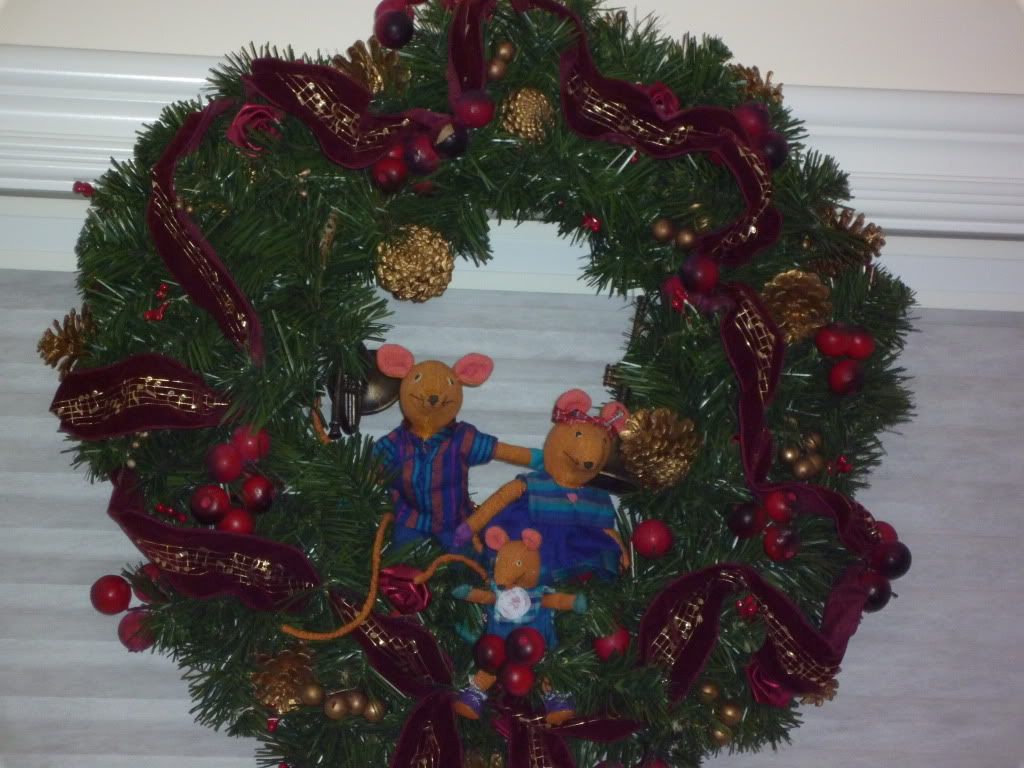
Ever since I was about eight years old, we have always put out the Christmas mice. The mice are fairly subtle; the family sits in a wreath given to us by my grandmother and the angel mouse tops our tree. So why the mice?

When I was seven or so, my mom caught the end of a Christmas special called "On Christmas Eve." The special is a silent, animated, short film with beautiful drawings and music that depicts a fairy's quest to bring Santa to the house of a chimneyless girl. I know, it sounds ridiculous, but it is so sweet. In one of the side plots, the fairy awakens a family of stuffed mice (who look exactly like our Christmas mice) to help her in her quest to bring Santa's slay to the little girl. We bought a copy on VHS many years ago, but we have never been able to find a DVD copy.

Recently, someone posted a poor quality version on youtube in three pars: 1, 2, 3. Enjoy!
Family of Chrismas mice.
Angel mouse in the tree.

Updates

I am going to spend a little bit of time updating old cooking posts with pictures, changes, and more information. Also, I will be trying to finish up posts on the Christmas traditions. For now, check out my updated pictures and the recipe on the Almond Thumbprint blogpost.

Update 12/28/10: I just added a picture of the soup to my blog "Traditions of the Servii, Part 3."

Update 12/29/10: I just added a series of hints about dough refrigeration to "Holiday Challah."

Sunday, December 26, 2010

Holiday Challah

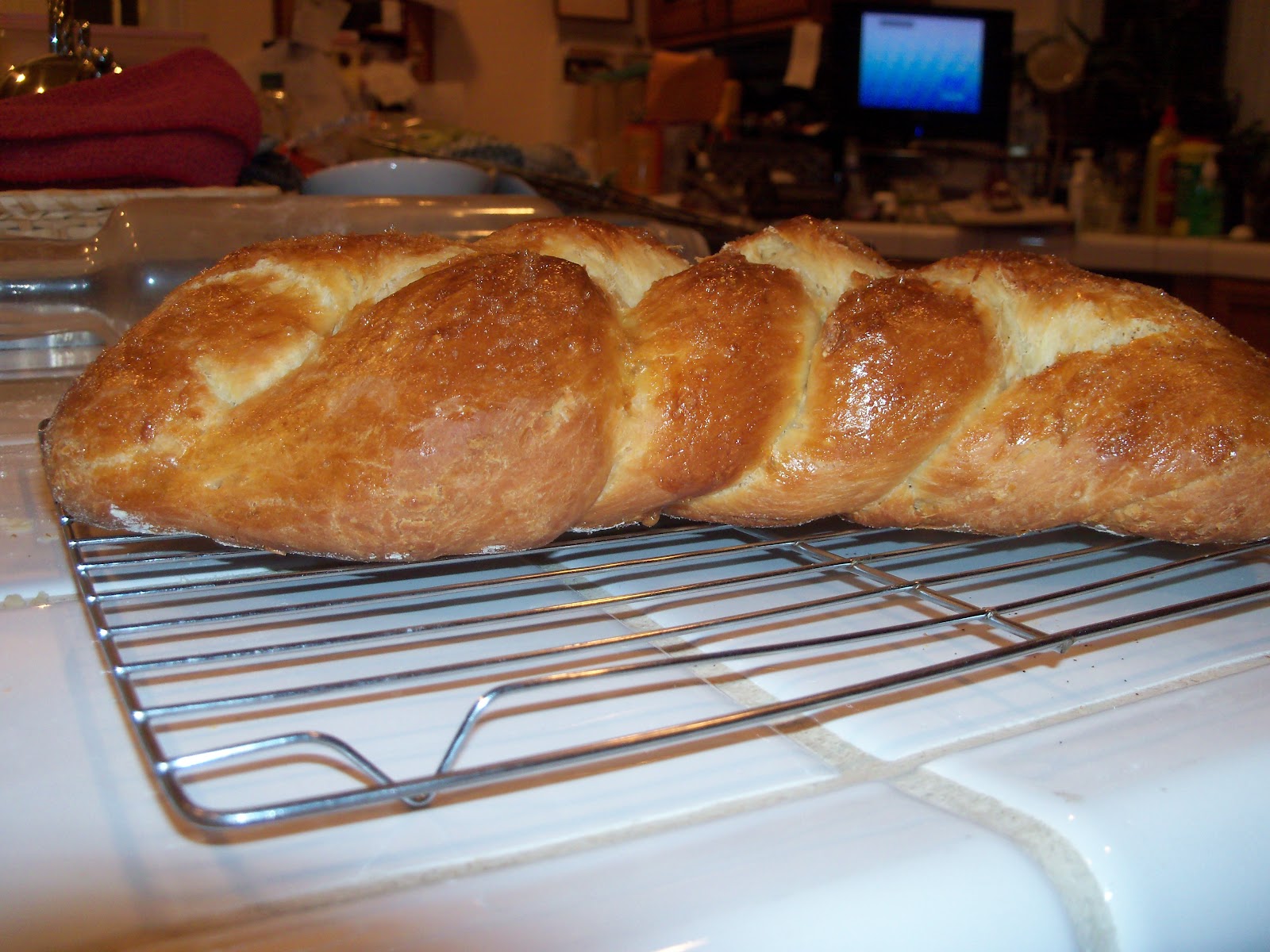
The smaller of my two braided loaves.
 I made some Challah for Christmas dinner. I was not planning on making any bread at all because I have not yet had a successful loaf that I have made since I graduated from college, but my mother sweetly encouraged and convinced me to make an easy bread recipe. My favorite no-hassle bread recipe is a Challah recipe from a blog I stumbled across called Tupper Cooks.

Until I ran across this recipe, I had never trusted no-kneed recipes. The first few that I tried produced thick, heavy bread and I decided that "no-kneed" was an altogether bad idea. However, I really wanted to make Challah for some friends for the end of passover, so I decided to try it out. It was perfect! It also made a great impression at Christmas dinner. My braiding is not very practiced, so my loaves are kind of misshapen, but they taste good.

In the oven, on my baking stone.

A picture of the crumb.

The larger loaf.

The smaller loaf.
This afternoon, I had a snack of toasted challah with left-over double-creme brie. Yum!

Note: you may notice, looking at Tupper's recipe, that this bread requires a much lower heat (350 degrees Fahrenheit instead of a more usually 450 degrees Fahrenheit). This, according Wild Bread, is because enriched breads (that include fats-- like eggs and oils-- and/or sugars-- like honey) brown faster and must be cooked at a lower temperature (Rayner 104). I thought that was pretty cool.

Update 12/29/10: I put half of the recipe in the refrigerator to make later (this challah can be toasted to heat it up, but it is much better fresh) . The recipe said that it could be refrigerated fro up to 5 days. I made the second half of it today. It turned out great but there are a couple of notes. First, I braided it right out of the refrigerator. After an hours, the bread had hardly risen at all, so I let it rise for another hour (for a total of 2 hours rising time). It did not rise very much-- only to about half the size of the original loaves. However, when I put it in the oven it had lots of oven spring (i.e. it puffed up a lot in the oven) and was about the same size as the original loaves. It tastes just as good. I highly recommend it!

Christmas Traditions of the Servii, Part 3

Happy Boxing Day! Boxing Day is a British tradition (I think from the middle ages) during which Lords would box up their old stuff that they were going to get rid of and give it to their serfs. Our Boxing Day traditions are slightly different, and most of them come from festivities from the previous day.

The Servii throw a large Christmas Day dinner for friends and family who are in town. The preparation (and cooking) begins directly after presents are opened. It is quite a feat to get it all together (especially because of some eccentric food preferences and allergies), but we all pitch in and make it work. This year we got a little behind because of all the baking, but the party was fabulous and all of the food turned out magnificently.

Turkey Soup and Turkey Quesadillas
I never used to like Turkey. As a kid I hated holiday meals because they involved turkey and green beans, neither dish of which I was particularly fond. In my sophomore year in college, a friend of mine hosted a Thanksgiving Dinner (during which, I think, I was very little help). I had one bite of her Turkey and thought "this is what turkey should taste like." I was hooked. As it turned out, she had used an old family recipe to brine the turkey, which ensured that it came out juicy and tender. So, for that Christmas, I took the recipe and did my own. Every year since, we have made the same the same turkey. I will post the brining recipe in a subsequent post.

One really exciting thing about this year's turkey is that I carved it myself-- or at least I carved half of it myself. I wanted to apply the principles in the video I watched after Thanksgiving (see my blogpost) to carving the Turkey. It was not quite as easy as it looked in the video so I thought I was doing it wrong, at first, and I called on the person who had carved the turkey at Thanksgiving Dinner. He came to my rescue by teaching me how to break the bones so I could separate the wings from the turkey, and beautifully sliced the meat from the bones and cut up the breasts as I carved gigantic chunks out of the turkey (as shown in the video). Amazingly, we got much more meat off the turkey than usual and it seems like an enormous amount of the 15lb pound turkey was left after 13 people had eaten it (three of the guests were vegetarians). Everyone said they loved the turkey, and I certainly love it and will enjoy using the leftovers in quesadillas, sandwiches, and enchiladas.

For now, the turkey carcass is in our big soup-pot, being made into broth with some left over vegetables (mostly carrots and celery).
A bowl of our soup. Yum!

The rest of the left-over turkey will be made into quesadillas. We make them very simply:


Ingredients
  • Cheese mixture, shredded, approximately 0.8-1oz, depending upon the size of the tortilla (we usually combine some left-over sharp cheddar from the appetizer at Christmas Dinner with some jalapeno or habanero jack cheese)
  • Green onions, minced
  • Turkey breast meat, sliced about 1/8 of an inch thick or so (we use the left-over brined turkey)
Directions
  1. Very lightly oil a pan with grape-seed or vegetable oil and heat the pan to medium.
  2. Warm the tortilla for about 30 seconds on each side
  3. Sprinkle the cheese over.
  4. Sprinklethe green onions over the cheese.
  5. When the cheese begins to melt, put the turkey on top.
  6. Fold the tortilla in half with a spatula.
  7. When the outside of the tortilla begins to crisp, flip it over to the other side.
  8. When the whole tortilla is slightly crisp, cut and serve.

The Clean-up
The cleaning process is usually a fairly high-spirited affair, although dinner did not finish until 11:45pm this year (well...dessert and conversation did not finish until then), so we were all pretty tired. However, as usual, we made cups of  tea and talked over the evening by the fire before the actual cleaning process. This is a tradition that I really enjoy because we get to exchange anecdotes from the evening and relax in the warm glow.

Happy Boxing Day!