Saturday, April 30, 2011

The Scientific Method?

Whole Wheat Loaf
Last week, I made a few loaves that ended up really heavy because the water did not cook all the way out of them. I managed to figure out what the problem was and fix it (although I stumbled on another minor problem). I realized that I had the pot turned open-side up when I was heating it. I this meant that the pot didn't get as hot during the heating process (or at least lost its heat more quickly) and meant that the bread did not cook as quickly under steam. So, I turned the pot open-side down and heated it that way. I also followed the directions and preheated the oven at 500 degrees (475 degrees F convection) before turning it down to 450 degrees (425 degrees F convection) to bake the bread. This seemed to work. The bread was moist and soft without being overly dense like last time.

The bread swelled, but did not spring up as much as I had hoped and ended up with a dip in the middle. I think this is because I did not leave it long enough under steam. It took a lot longer than I expected to reach the internal temperature of 212 degrees F (100 degrees C) than I expected (I had to leave it in for 6 minutes longer than I intended) so I think that if I leave it longer under steam, more of the water might cook out and then it would require less cooking time after removing the steam.
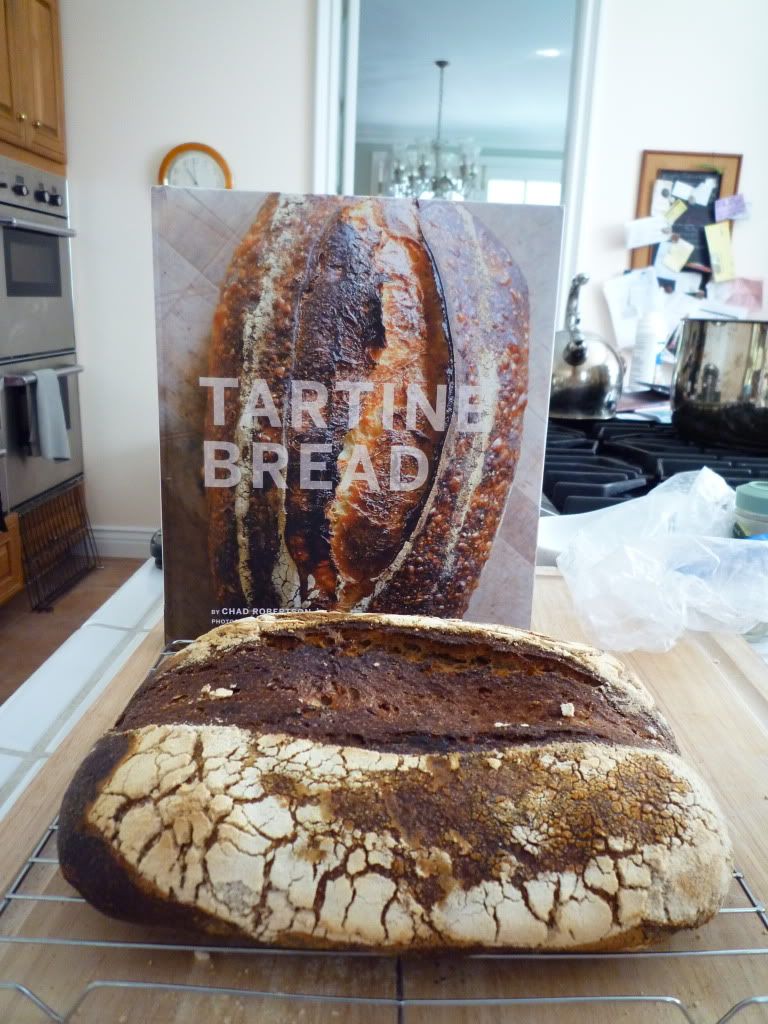
Nice, dark, "burnished" crust
 Looks burnt, but it actually tastes wonderful.
Whole Wheat Bread with the Recipe
Finally managed to get a minor "ear" on the crust
Still need to work on shaping and scoring, but I am getting better.

Yum!
Crumb not as open as I would like.
The loaf did not expand as much as I had hoped, but it tastes absolutely amazing. The toasted flax seeds lend a nice nutty flavor to the bread and the crust is wonderfully crunchy and sweet. The bread recipe is originally from Tartine Bread, and I modified it here.

Friday, April 29, 2011

(Almost) Whole Wheat Country Bread with Toasted Flax Seeds

Finally I am beginning to feel better and my math test is over. So, I am making more bread.

I have been making the Tartine loaves for a while now. With the exception of a problem last week (which I am looking into), I have had a lot of success with it. So I decided to try making it with toasted flax seeds. Flax seeds are awesome. I have a genetic predisposition to high cholesterol and taking flax oil or eating flax seeds helps keep it down. Furthermore, toasted flax seeds have a wonderful nutty flavor. So I decided to incorporate about 1/3 of a cup of toasted flax seeds into my 70% whole wheat loaf. I posted the recipe here. I will post pictures when it comes out of the oven tomorrow morning.
Near the Last Turn
 One of my sheets ripped recently. We washed it and cut it up and I floured it and used it to line the loaf pan that served as the proofing basket for this bread. My shaping technique is still rather poor, especially when forming batards.
Bread Proofing

Update 04/30/11: Bread came out fairly well. Updates here.
Lovely Crust

Wednesday, April 27, 2011

Wine Snob: Wines from the 80s and 90s

When my uncle and aunt were here, they brought down a variety of wines from their wine cellar that they have collected over the years. Most of the wines are from California vineyards that they visited over the years. I tried two different red wines while they were here which were very old. I also learned a few things about judging red wines.

The first wine I tried was a 1993 Reserve Concannon Petite Sirah. I had a Limited Edition Concannon Petite Sirah 2006 a while ago and I thought it was a bit bland. The 1993 was certainly not bland. I liked it well enough, but it wasn't quite to my taste. It was a little thick-- full bodied and slightly viscous tasting. Dark purple, it tasted like blackberries and blueberries. It had a bright fruity taste with a light finish. Apparently Concannon was the first and one of the few vineyards in California that bottles Petite Sirah as a varietal (i.e. not mixed with other grapes). I have had one Petite Sirah varietal I liked, but this one was not my favorite, although it was certainly interesting.

The other wine I tried was a Silver Oak Alexander Valley Cabernet Sauvignon 1985. My uncle acquired the wine back in the 1980s. Now, as it has aged for many years, it is both the oldest and probably the most expensive wine that I tried. Apparently, the wine was supposed to be past its prime. However, the wine not only tasted fabulous but apparently also was not past its prime. According to my uncle, you can tell that a red wine is past its prime if, looking at a glass of the wine from below, you can see a wide ring of brown around the top of the wine. This wine only had a slight tinge of brown around the edge of the top of the wine.
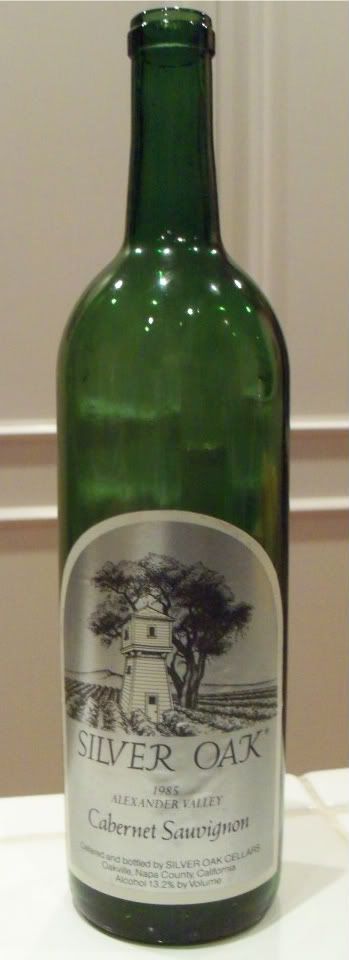
Silver Oak 1985
Furthermore, the taste was fantastic. The wine was very smooth. My aunt said that it tasted as though the the wine would have had a heavy tannic taste if it had been drunk while it was young, but the tannins relaxed over time. At the time we drank it, it was a nice medium-full body, with smooth flavor and mild tannins. It was a wonderful compliment to food and was a rich brick red color.
Monday, April 25, 2011

Two Steps Forward, One Step Back

It seems to be one thing or another with my bread baking. Most of the blogs I read-- and learn from-- seem to consistently make these beautiful loaves. I, too, have made some great-tasting loaves, but something always seems to go wrong. Usually I can ascribe these "wrongs" to something I've done (overproofing, underproofing, poor shaping, poor scoring, etc) and even if I can't do it immediately I can usually find some kind of a scientific explanation, but right now I seem to be in a place where I am just lost. No explanation I can think of. Here's the problem: starting yesterday, the water has no longer been cooking out of my bread. I can't explain it. I tried reducing the time under steam, but the problem remains. Three different loaves. It makes no sense. Anyway, I decided to cook a small loaf (1/3 of the recipe) of Wild Yeast's Norwich More-Sourdough for our Easter luncheon. I fermented it overnight in the refrigerator. It tasted wonderful, but it was heavy and dense. Much of the water didn't cook out of it. Nice crust, though.

Norwich More-Sourdough
Close up:
Nice blistered crust

Irregular crumb, but the water didn't cook out.

The other two loaves I made were one whole wheat and one country Tartine loaf. Once again, the loaves were very good, but extremely heavy. Once again, the water just did not cook out of them. I also had some trouble with a banneton (see below). However, the loaves bloomed and colored nicely and the taste was good. Why did the water not cook out? I don't know. I just don't get it. Ideas, anyone?
Tartine Loaf
 The crumb was weird:
Weird Tartine Crumb
Just as I thought it was impossible to make a mistake when following the recipe of the Tartine loaf...

Friday, April 22, 2011

The 100% Whole Wheat Experiment, Part #2

This is what I did to make the loaf I posted about recently. I am going to try out small emendations and re-post with my next loaf. The recipe is an altered version of the "100% Whole Wheat Sourdough Hearth Bread" from Peter Reinhart's Artisan Bread Every Day. d

Ingredients
Starter
  • 57g 100% hydration whole-wheat starter
  • 170g whole grain flour
  • 170g water (about 90-95 degrees F)
Final Dough
  • All of the starter
  • 1 tablespoon honey
  • 350g water about 80 degrees F (I only used 340g in my last attempt and it was denser than I would have liked)
  • 454g whole wheat flour
  • 14g salt
Directions
Day 1:  Note: if you start this in the morning, you can make this bread in two days. If you start it in the afternoon or the evening, it will take three days.
  1. Stir the starter, water, and flour together. 
  2. Cover with plastic wrap or equivalent and let it sit for 6-8 hours at room temperature (presumed as between 68-72 degrees F).
  3. After the 6-8 hours, you can use it or refrigerator overnight for up to two days.
  4. To make the dough, after the 6-8 hour period, put the starter into a large mixing bowl and stir in the water. Distribute the starter throughought the water.
  5. Stir in the flour and salt. Mix the dough until it becomes a shaggy mass.
  6. Let the dough sit for five minutes to fully hydrate the flour.
  7. Knead the dough for 10 minutes. It will be quite sticky.
  8. Slightly wet a surface (or slightly flour it) so that the dough won't stick and use the stretch-and-fold technique, completing the 4 stretch-and-folds within 40 minutes.
  9. Cover the dough with plastic wrap or equivalent and let the dough to rise for 2-3 hours at about 72-75 degrees F.
  10. Put the dough in the refrigerator for 8-12 hours. If you want to, you can divide the dough into two before you place it in the refrigerator to bake on two separate days.
Day 2 (baking day)
  1. Remove the dough from the refrigerator four hours before baking. Lightly flour a surface and put the dough on a surface and divide the dough into two pieces.
  2. Let it sit under plastic wraps or an overturned bowl for 20 minutes
  3. Shape the dough into loaves and let them rise in bannetons, on a couche, or similar. Let them rise for 3.5 hours at 75 degrees.
  4. Preheat the baking stone to 450 degrees F (or 425 degrees F convection) for 30 minutes and preheat a broth pot or similar for the last 15 or heat a combo cooker for 30 minutes.
  5. Prepare a floured peel and turn the bread onto the peel and score it. Put it in the oven and place the top of the combo cooker or the overturned brothpot on top.
  6. After 15 minutes, take off the pot or lid. Let the bread cook for another 30-40 minutes.
  7. Take the bread out and place it on a cooling rack (it should bet about 205 degrees F on the inside). Let it sit for 45 minutes before cutting into it.

Wednesday, April 20, 2011

Shaping Bread

One of the areas of bread making in which I need the most work is bread shaping. It is easy to learn a recipe or chemistry from a book and I am fortunate to have been given some great books and that my local library system has a lot of other great cookbooks. But the one thing that I find difficult to learn without an expert leaning over my shoulder is bread shaping. Even the videos I watch online are difficult to follow because sometimes my dough behaves differently. I did find one great shaping video from the Back-Home Bakery I would like to share and I will let everyone know how it goes.


On a slightly different note, I have mentioned Peter Reinhart's stretch-and-fold technique. Here is a great video from the man himself to help you see what I mean.


Happy baking!

Tuesday, April 19, 2011

Crisis-Averted Focaccia

Focaccia in an iron skillet
So while we had company here, we decided to make some of my semi-sourdough pizza crust and have everyone add their own toppings. My mom decided to help out, because I was making some other bread at the time. She forgot to measure the water and ended up with what appeared closer to sourdough soup than anything else. We estimate the volume she put in, weighed it, and recalculated the 68% hydration for the dough and estimated the rest. It was about 2.5 times the volume, so instead of making 6 pizzas there was enough dough for about 15. We made the pizzas for dinner-- they went like hotcakes-- and we froze most of the rest of the dough.
Two pieces of dough managed to escape the freezer, so we decided to make some focaccia. Servia got some rosemary from the garden, minced some garlic, and drizzled the bread with olive oil and a little garlic salt. After letting it rise for an hour, we baked the focaccia for 20 minutes in an iron skillet, the first 5 minutes under a pan lid to let it rise sufficiently in the oven. The focaccia seems to have made Servia feel a little bit better. The whole family seems to have come down with a cold or the flu. Even with my clogged sinuses, the roasting garlic smelled great.

Monday, April 18, 2011

Wine Snob: Zinfandel Port and Late Harvest Sauvignon Blanc

I have never liked a dessert wine. They are simply too sweet for me. My uncle and aunt came to town and brought a whole bunch of wine with them. They brought down two dessert wines. I was not particularly keen to try them, but I decided that I would take a taste. They were not bad. The port was very dry (for port). According to my aunt an uncle, there are two possible processes for Port. Generally, port is made by the Solera process, which means that the port is mixed from a series of years so that the average age of the wine slowly increases. For incredibly good years, vintners make what it called a vintage which is the wine of a single year. We had a vintage. I think it was a 1999 vintage, Zinfandel Port, but unfortunately the bottle seems to have disappeared. It might have been Selby winery. Once again, I'm not sure. The port itself was pretty good. It was thick and had a bit of a taste of honeycomb.

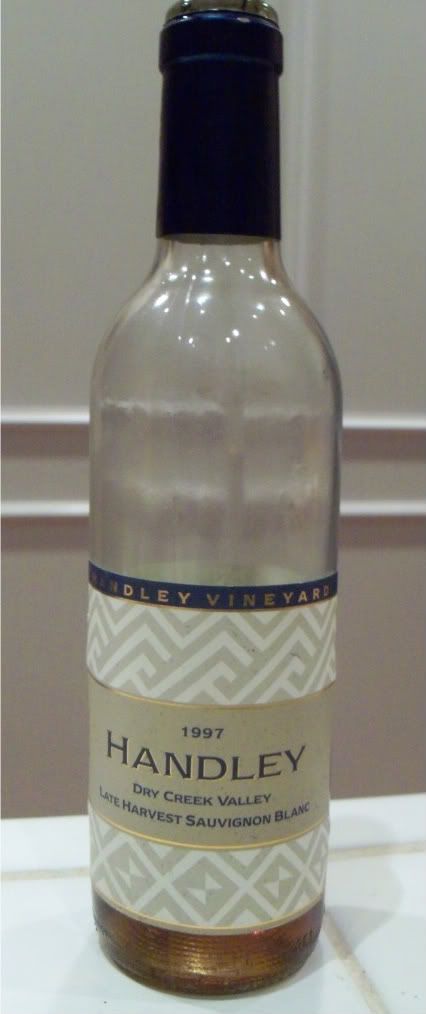
The other wine was a Late Harvest Sauvignon Blanc.

This Handley Vinyeards 1997 Late Harvest Sauvignon Blanc was a true dessert wine with 15% residual sugars. Very sweet with the color and taste of honey. It went incredibly well with strawberries. I like my strawberries slightly underripe so they were nice and tart and knocked down the sweetness of the wine. I enjoyed both of the wines more than I expected to.